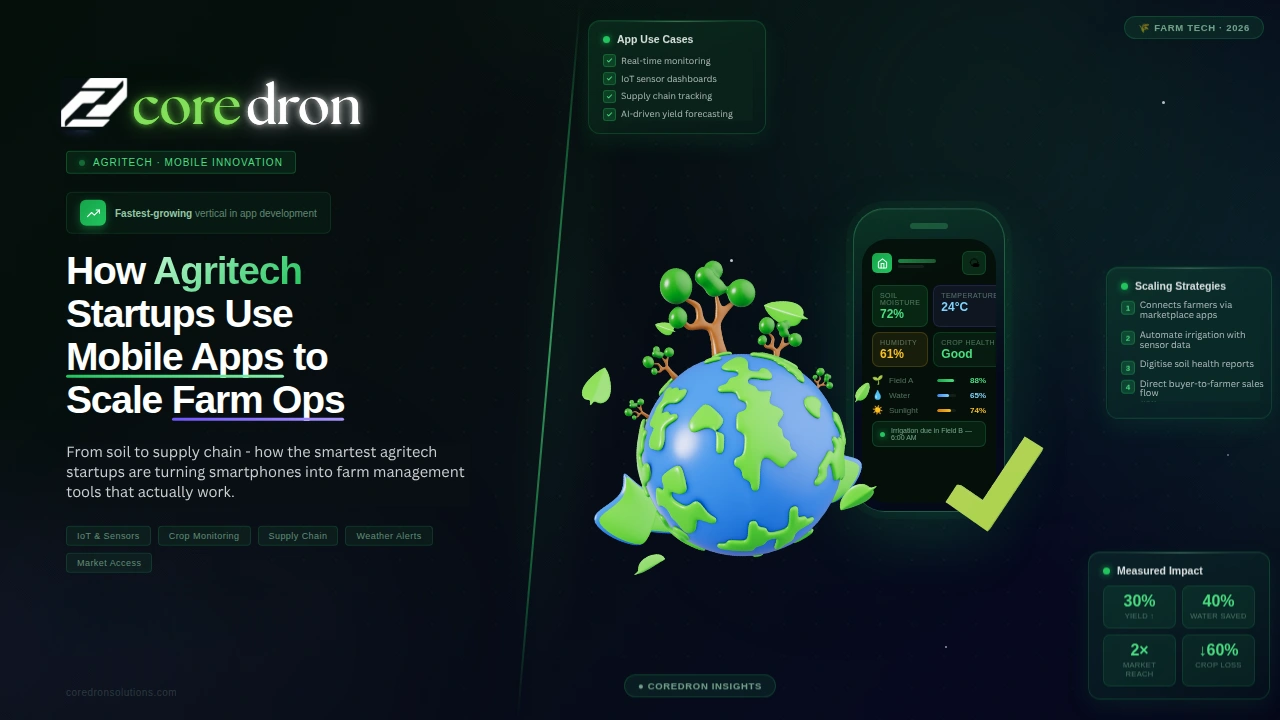
A farmer makes an irrigation call early in the morning. By afternoon, the weather changes. That one decision can affect the entire yield.
That kind of uncertainty is still part of farming.
What’s changing now is how those decisions are made.
Farming is slowly becoming more data-driven. Even basic digital tools are making an impact. In many cases, farms using them report yield improvements of 15–20% and better control over inputs such as water and fertilizer.
Not dramatic shifts overnight, but enough to matter. A lot of this change is happening through mobile apps.
Farmers are using them to check weather updates, track crop conditions, manage activities, and even compare market prices before selling. It’s not replacing experience. It’s just giving more visibility where there wasn’t much before.
That’s exactly why agritech startups are moving into this space.
Agriculture remains one of the least digitized industries, yet it employs a large share of the workforce in markets like India. The gap is obvious. And mobile-first solutions are starting to fill it.
In this guide, we’ll learn more about agritech mobile app development and how these apps are actually being used, what features matter on the ground, and where things tend to get difficult when you build for real farm conditions.
What Is Agritech and How Are Mobile Apps Changing It?
Agritech mobile app development refers to building digital applications that help farmers manage operations, monitor crops, track resources, access market data, and improve decision-making using mobile technology.
These applications support modern farming through automation, real-time insights, and data-driven operations.
Where agritech fits in:
At its core, agritech helps farmers handle everyday challenges with better information:
- Managing water and irrigation
- Monitoring crop health
- Planning around weather changes
- Getting better visibility into pricing
None of this is new. What’s changed is how accessible it has become.
How mobile apps are changing day-to-day farming
This is where the real shift is happening. Mobile apps bring all of this into one place. More importantly, into something farmers already use.
- Check the weather before planning the day
- Track crops without manual records
- Get alerts for pests or sudden changes
- Compare market prices before selling
Individually, these are small actions, but together, they reduce guesswork.
Why does this matter now?
Smartphone usage has grown quickly, even in rural areas. That’s what makes mobile apps practical. Farmers don’t need new systems or heavy setups. Just a phone and a working connection.
For agritech startups, this changes the approach. Instead of building complex platforms, the focus shifts to simple, useful tools that fit into daily routines. That’s what drives adoption in real conditions.
How Mobile Apps Are Revolutionizing Farm Operations
Mobile apps come in handy almost every single day. They influence major farming decisions in small, optimized steps across how farms are monitored, managed, and connected to markets.
- Real-Time Farm Monitoring
Earlier, farmers relied on physical checks. Now, a lot of that visibility is instant.
- Weather updates throughout the day
- Soil and moisture insights (where available)
- Alerts for sudden changes
This doesn’t remove risk completely. But it helps farmers react faster rather than guess.
- Precision Agriculture
Farming decisions are becoming more targeted rather than uniform with the agricultural technology app. They now allow users to check:
- Water usage based on actual need
- Controlled use of fertilizers
- Early detection of crop issues
Even small adjustments here can improve yield. Many farms see better output simply by avoiding overuse.
- Farm Management & Planning
Daily operations are becoming more structured.
- Track activities like sowing and harvesting
- Maintain records digitally instead of manually
- Plan tasks based on real conditions
It saves time but, more importantly, reduces missed steps during critical periods.
- Market Access & Direct Selling
This is where the financial impact becomes visible.
- Check live market prices.
- Compare rates before selling.
- In some cases, connect directly with buyers.
For many farmers, better price visibility alone can improve margins.
What does this really mean?
Individually, these changes feel small. Together, they reduce uncertainty, improve decisions, and make farm operations more predictable over time.
Agritech Industry Overview: Market Size and Growth
Agritech software in India has been around for a while. What’s changed recently is the pace. A few years back, it was a niche space.
Now it’s getting serious attention. Most estimates put the global agritech market at around $20–25 billion today. If the current trend holds, it’s expected to move toward $40 billion in the coming years.
Growth isn’t explosive, but it’s steady, usually in the 10% range year-on-year.
What’s driving the change?
- Agriculture is still massive. But large parts of it are under-digitized. That gap is what startups and investors are reacting to.
- Funding has picked up, especially in areas like farm management, supply chains, and precision agriculture.
- Not every startup works out, but the direction is clear.
In India, the push is coming from scale: a large farming base, rising smartphone usage, and clear inefficiencies. In the US, the focus is more on advanced tech and large-scale operations.
In emerging markets, the opportunity is still wide open. Less competition, but more ground challenges. So the growth isn’t coming from a single source. It’s happening in different ways across regions.
Why Mobile Apps Are Critical for Scaling Farm Operations
Scaling a farm isn’t just about expanding land or increasing output. It’s about doing the same things, more consistently, with fewer mistakes. That’s harder than it sounds, and this is where mobile apps start to matter.
Here are some factors on why mobile apps are critical for scaling farm operations:
1. Accessibility
A few years ago, most tools for digital agriculture in India didn’t reach farmers directly, but smartphone usage in rural areas has risen quickly.
In many places, the phone is already there. That removes the biggest barrier. No extra setup or complex system, just an app that works.
2. Real-time decision-making
Farming decisions are time-sensitive. When you wait too long, it costs you the crops. Mobile apps bring in updates when they’re actually needed.
Weather shifts, crop alerts, basic recommendations. Nothing fancy, but enough to act faster. This way, even small timing improvements can prevent losses.
3. Data tracking and continuity
Earlier, most information stayed in memory. Or in a notebook that’s hard to reuse. It can now be tracked over time.
- What was planted
- When it was treated
- How it performed
It doesn’t feel like a big change at first. But over seasons, patterns start to show up.
4. Cost and efficiency improvements
This is where the impact becomes visible. When decisions improve, even slightly, costs start to come down.
- Less overuse of water or fertilizers
- Fewer repeated mistakes
- Better yield over time
Not perfect outcomes. Just better ones, consistently.
Mobile apps don’t transform farming overnight, but they reduce guesswork. Over time, that’s what actually scales operations.
Top Mobile App Use Cases in Agriculture
Most agrit-ech platform apps don’t try to do everything. They focus on a few problems that show up every day on farms. Fix those, and things start improving on their own.
Farm Management and Planning
A lot of farm work still runs on memory. What was planted when, and what needs to be done next? Apps change that, slowly.
They let farmers track crop cycles and plan tasks such as irrigation and spraying. Nothing complex, just a clearer way to stay on top of things. Over time, this reduces the number of missed steps, and that alone makes a difference.
Weather Forecasting and Alerts
The weather is still unpredictable; it’ll always be. But mobile apps have changed how we access it. Instead of waiting or guessing, farmers can check updates during the day.
Some apps also send alerts when conditions shift. It doesn’t guarantee the right decision. But it gives a better chance of making one.
Supply Chain and Market Access
Selling has always been tricky. Prices change, markets vary, and information isn’t always clear. Apps are starting to close that gap.
Farmers can check prices, compare options, and sometimes connect directly with buyers. For many, just knowing the right price at the right time changes the outcome.
Equipment and Resource Management
Equipment issues usually show up at the worst time.
Mobile apps help track usage and plan maintenance a bit better. Even basic tracking helps avoid sudden breakdowns.
The same goes for resources like water or fuel. When you can see usage, you manage it differently.
Crop Monitoring and Analytics
This is where things start shifting toward data. Farmers can track crop health over time. Some use sensors, others just log observations.
It’s not always detailed. But patterns start to show. And once you see patterns, decisions get easier.
Financial and Payment Solutions
Money flow is often uneven in farming. Precision farming apps are making this slightly easier to manage.
Payments can be digital, records are easier to track, and in some cases, access to credit becomes simpler. It’s not a complete fix, but it removes some friction.
What does this come down to?
None of these changes feels big on their own. But together, they reduce guesswork. That’s what actually improves farm operations over time.
Technologies Powering Agritech Mobile Apps
Most agritech apps may look simple on the surface. But behind them, a mix of technologies is doing the heavy lifting. You don’t always see it directly; you just see the output.
Here’s a closer look at the technologies powering agritech mobile apps:
Artificial Intelligence & Machine Learning
This usually shows up as recommendations. Based on past data, weather patterns, or crop behavior, apps suggest what to do next:
- When to irrigate
- When to spray
- Sometimes, even what to expect in terms of yield
It’s not perfect, but over time, it gets better as more data comes in.
Internet of Things (IoT)
This is where real-time field data starts to come in. Sensors placed in the soil or on equipment track variables such as moisture levels, temperature, and usage.
That data goes straight to the app. Instead of checking manually, farmers can just look at their phones to see what’s happening.
Cloud Computing
All this data has to go somewhere. Cloud systems store and process it so it can be accessed at any time.
It also allows apps to work across devices without losing information. For farmers, this part is invisible. But it’s what keeps everything running in the background.
Blockchain for Supply Chain Transparency
This is more common in supply chain-focused apps. It helps track produce from farm to market.
Each step gets recorded, making it easier to verify where something came from and how it moved. It’s still early in adoption, but it’s useful where trust and traceability matter.
Satellite Imaging & Remote Sensing
This brings a broader view. Instead of looking at one part of the field, satellite data helps monitor large areas.
Crop health, soil conditions, and changes over time can be tracked without being physically present. It’s especially useful for larger farms or remote locations.
Must-Have Features for Farm Management Mobile Apps
A farm app doesn’t need to be complex. But it does need to be useful in daily work. The features below are not “nice to have.” They’re what make the app usable in real conditions.
Here’s a closer look at some must-have features for farm management apps:
- User Dashboard:
This is the first thing a farmer sees. It should give a quick overview without too much detail of what’s happening on the farm, what needs attention, and any alerts. If the dashboard is confusing, the app won’t be used. Simple matters here.
- Task and Activity Tracking:
Farming runs on tasks. And missing one can affect the entire cycle. Apps should make it easy to track daily work. What’s done, what’s pending, what’s coming next. It doesn’t have to be detailed. Just clear enough to follow.
- Weather Integration:
The weather is part of almost every decision. Having forecast data in the app saves time and helps plan more effectively. Even basic updates, such as rainfall or temperature changes, are enough to guide actions. The key is timing. Information should come when it’s needed.
- Inventory and Resource Management:
Seeds, fertilizers, water. These are not always tracked closely. An app can help keep a simple record. What’s available, what’s used, what needs to be restocked. This avoids last-minute shortages and unnecessary purchases.
- Data Analytics and Reporting:
Over time, data starts building up. Apps should turn that into something useful. Not complex charts, but simple insights. What worked, what didn’t, what changed. Even basic trends can help improve decisions in the next cycle.
- Offline Functionality:
Connectivity is still an issue in many farming areas. If the app stops working without an internet connection, it won’t be reliable. Core features should work offline and sync later when the connection is back.
- Multi-language Support:
Many farmers are more comfortable in local languages. If the app only works in one language, adoption drops. Supporting regional languages makes it easier to use and understand. This one change can decide whether the app is used or ignored.
Challenges in Agritech Mobile App Development
Building for agriculture looks simple from the outside. In reality, most challenges show up only after the app reaches real users.
#1 Limited internet connectivity
Many farming regions still don’t have stable internet. An app that depends on constant connectivity will struggle. Features need to work offline, with data syncing later. If that’s not handled well, usage drops quickly.
#2 Low digital literacy
Not every user is comfortable with apps. Complex flows, too many options, or unclear instructions create friction. The app has to feel intuitive from the first use. Otherwise, even useful features go unused.
#3 Device compatibility issues
Farmers don’t always use the latest smartphones. Apps need to run smoothly on older Android devices with limited storage and lower processing power. Ignoring this can limit adoption more than anything else.
#4 Data accuracy and reliability
Decisions depend on the data provided. If weather updates, crop insights, or recommendations are off, trust breaks. And once that happens, users rarely come back to the app.
#5 Integration with hardware (IoT sensors)
Connecting apps with sensors or devices adds another layer of complexity. Data syncing, device reliability, and maintenance all come into play. If the integration is not stable, the entire system feels unreliable.
Benefits of Mobile Apps for Agritech Startups
Despite the challenges, the upside is clear. When done right, mobile apps create a measurable impact for both startups and farmers.
- Scalability of operations
Mobile apps allow startups to reach more users without heavy infrastructure. Once the product works, it can be expanded across regions with relatively lower effort. That’s what makes scaling possible.
- Improved productivity and yield
Better information leads to better decisions. Even small improvements in timing, resource use, or planning can increase output over time. Many farms see gradual gains rather than sudden jumps.
- Cost reduction and resource optimization:
Apps help reduce waste. Water, fertilizers, and labor can be used more efficiently when there’s visibility into usage. Over time, this leads to lower operational costs.
- Better decision-making with data:
Instead of relying solely on experience, farmers use data to support their decisions. Past records, patterns, and insights make it easier to plan ahead and avoid repeated mistakes.
- Increased farmer engagement and retention
When an app is useful, farmers keep coming back to it. Regular usage builds familiarity, and over time, the app becomes part of daily operations. This also helps startups retain users without constant effort.
Step-by-Step Guide to Building an Agritech Mobile App
There’s no fixed formula here. But most successful apps in this space follow a similar path. Not perfectly, but close enough.
Step 1: Identify Target Users
Start with clarity on who you’re building for. Farmers, suppliers, buyers. Each group has different needs. A farmer may care about crop tracking. A buyer may care about pricing and supply. Trying to serve everyone at once usually creates confusion. It’s better to pick one group and go deeper.
Step 2: Define Core Features and MVP
It’s tempting to build everything at once. That rarely works. Focus on a few features that solve a real problem. Something users will actually come back for. Keep the first version simple. If it works, you’ll know quickly. If it doesn’t, it’s easier to fix.
Step 3: Choose the Right Tech Stack
This is important, but it doesn’t need to be overcomplicated. The stack should meet basic requirements such as offline use, smooth performance, and future scalability. Fancy tech doesn’t matter if the app struggles in real conditions.
Step 4: Design for Low-Bandwidth Environments
This is specific to agritech. The app should work even when the internet doesn’t. That means lightweight design, minimal data usage, and offline functionality where possible. If the app fails without a connection, users won’t rely on it.
Step 5: Develop, Test, and Deploy
Mobile App Development is not just about building features. Testing needs to happen in real scenarios. Different devices, weak networks, and actual user conditions. Many issues only show up outside controlled environments.
Step 6: Continuous Improvement via Feedback
Launch is just the starting point. User feedback matters more than assumptions. What features are used, what gets ignored, and where users drop off. Improvements should come from real usage, not guesswork.
Future Trends in Agritech Mobile Apps
What’s coming next in agritech isn’t a sudden shift. It’s a gradual move toward more informed, automated, and connected farming. Some of these trends are already visible. Others are still early, but gaining traction.
- AI-powered predictive farming:
Instead of reacting to problems, farms are starting to anticipate them. Apps are beginning to use historical data, weather patterns, and crop behavior to predict outcomes.
Things like potential yield, pest risks, or the best time for certain activities. It’s not always precise yet. But it’s moving decision-making from reactive to slightly proactive.
- Drone integration:
Drones are slowly finding their place in agriculture. They’re being used for field mapping, crop monitoring, and even spraying in some cases.
When connected with mobile apps, the data collected can be viewed and acted on more easily. Right now, this is more common in larger farms. But adoption is expected to grow.
- Smart irrigation systems:
Water usage is becoming more controlled. Apps are starting to connect with irrigation systems to automate when and how much water is used.
Instead of fixed schedules, decisions are based on soil conditions and weather data. This helps reduce waste and improve efficiency over time.
- Digital marketplaces for farmers:
Selling is moving beyond local markets. Mobile platforms are enabling farmers to connect directly with buyers, compare prices, and choose where to sell.
This reduces dependency on intermediaries and improves price visibility. Adoption is still uneven, but the direction is clear.
- Climate-smart agriculture solutions:
Climate impact is becoming harder to ignore. Apps are starting to guide farmers toward practices that adapt to changing conditions.
This includes crop recommendations, water management strategies, and risk alerts. It’s not just about sustainability. It’s about managing uncertainty better.
Conclusion
Mobile apps are no longer optional in agriculture. They’re becoming part of how farms operate day to day. What started with simple tools like weather updates has moved toward planning, tracking, and decision-making. Not all at once, but steadily.
A big part of this shift is coming from startups.
They’re building solutions that fit real farm conditions, not just ideal scenarios. Some focus on productivity, others on market access or financial tools. Together, they’re pushing the industry forward.
But one thing still matters more than anything else – Usability.
If the app is not easy to use, it won’t be used, and if it can’t handle growth, it won’t scale. Getting both right is what separates useful products from everything else.