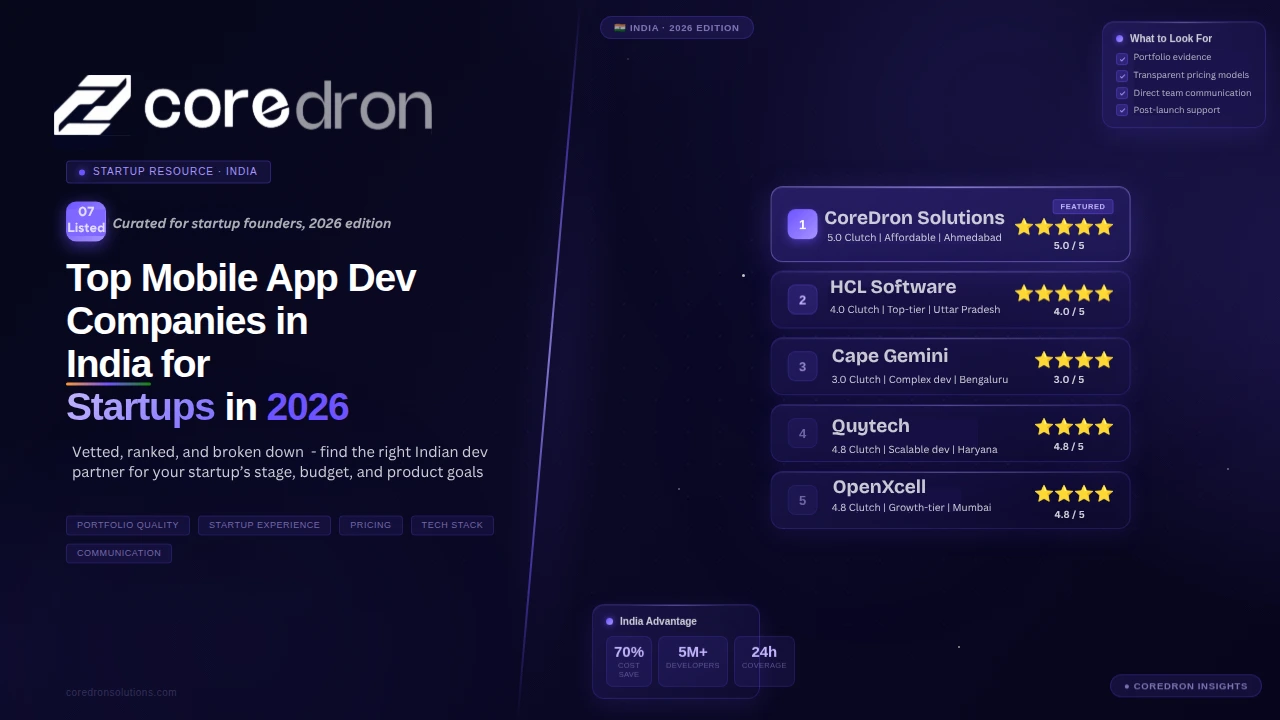
Mobile app development companies in India are widely chosen by startups for cost efficiency, scalability, and access to experienced developers.
According to Statista, mobile apps are expected to generate over $935 billion in revenue worldwide, which explains why more startups are investing in app-first experiences.
India often comes up as a preferred outsourcing destination. The combination of cost efficiency and access to skilled developers makes it an obvious option on paper.
In practice, the decision is less straightforward. Not every development company is well-suited to early-stage products, and choosing the wrong partner can slow progress more than expected.
This is where most founders get stuck. The question is not just where to outsource, but which company best fits the product’s stage and needs.
This guide looks at mobile app development companies in India from that perspective. It focuses on teams that work well with startups and explains what to consider before making a decision.
What Are the Best Mobile App Development Companies in India for Startups?
India remains one of the largest outsourcing hubs for software development, with thousands of companies working with global startups and enterprises.
Data from NASSCOM Strategic Review 2026 highlights that the Indian IT industry is projected to cross $315 billion in revenue, playing an important role in supporting international product development.
The companies below are evaluated based on what matters most to startups: stage fit, flexibility, scalability, and ability to support evolving product needs.
Top Mobile App Development Companies in India for Startups (2026)
The companies below are evaluated based on what matters most to startups: stage fit, flexibility, scalability, and ability to support evolving product needs.
1. HCL Software – Enterprise-Grade Technology and Scalable Systems
Quick Snapshot
| Detail | Value |
|---|---|
| Founded | 2019 |
| Clutch Rating | 4.0+ |
| Average Rate | $50 – $99/ hr |
| Minimum Project Size | $10,000+ |
| Team Size | 10,000+ |
HCL Software is one of the largest IT services companies globally, known for its structured approach and ability to handle large-scale systems. It brings deep technical expertise and established delivery processes across industries.
For startups, HCL is usually a better fit once the product has matured and requires stability, integrations, or enterprise-level scalability. Early-stage teams may find the setup more process-heavy than needed at the beginning.
- Best for: Enterprise-scale hi products and long-term systems
- Stage fit: Growth-stage to large startups
- Strength: Strong infrastructure and global delivery
- Consideration: May feel structured for early-stage teams
2. CoreDron Solutions
Quick Snapshot
| Detail | Value |
|---|---|
| Founded | 2021 |
| Clutch Rating | 5.0+ |
| Average Rate | $25 – $100 / hr |
| Minimum Project Size | $5,000+ |
| Team Size | 10+ |
CoreDron focuses on building custom mobile applications aligned with business workflows rather than just delivering features. The approach is centered around clarity in requirements and structured execution.
This tends to work well for startups that are still shaping their product as they build it. Instead of jumping straight into development, the focus remains on defining the right scope first and then scaling the product in a controlled way.
- Best for: Early to mid-stage startups
- Stage fit: MVP to scaling phase
- Strength: Structured development on a budget
- Consideration: More process-driven than freelance-style teams
3. Persistent Systems
Quick Snapshot
| Detail | Value |
|---|---|
| Founded | 1990 |
| Clutch Rating | 4.5+ |
| Average Rate | $25 – $49/ hr |
| Minimum Project Size | $25,000+ |
| Team Size | 10,000+ |
Persistent Systems has a strong reputation in enterprise technology and digital transformation. It is known for building systems that require robust backend architecture and long-term scalability.
Startups usually consider Persistent Systems when their product requires deeper integrations or operates at a larger scale. For early MVP development, the structure may feel slower than that of smaller teams.
- Best for: Complex systems and backend-heavy applications
- Stage fit: Mid to late-stage startups
- Strength: Enterprise-grade architecture
- Consideration: Less suited for fast-moving MVP cycles
4. Algoworks
Quick Snapshot
| Detail | Value |
|---|---|
| Founded | 2006 |
| Clutch Rating | 4.9+ |
| Average Rate | – |
| Minimum Project Size | $10,000+ |
| Team Size | 1,000+ |
Algoworks offers a wide range of technology services, with experience across industries like telecom and financial services. It is well-suited for projects that require both development and system-level execution.
For startups, it becomes relevant when requirements are clearly defined, and the focus shifts toward execution and scaling. The structure works best when there is clarity in scope.
- Best for: Industry-specific platforms (telecom, fintech)
- Stage fit: Growth-stage startups
- Strength: End-to-end delivery capabilities
- Consideration: Works better with a defined scope
5. Analogue IT Solutions
Quick Snapshot
| Detail | Value |
|---|---|
| Founded | 2017 |
| Clutch Rating | 5.0+ |
| Average Rate | $25 / hr |
| Minimum Project Size | $1,000+ |
| Team Size | 250+ |
Analogue IT Solutions combines product design and engineering, making it suitable for apps where user experience plays a key role. It focuses on building digital products that are both functional and intuitive.
Startups that prioritize usability and front-end experience often consider Analogue IT Solutions. The approach works well when design is as important as the underlying technology.
- Best for: Design-focused digital products
- Stage fit: Early to mid-stage
- Strength: Strong UX and development balance
- Consideration: Slightly higher cost for design-heavy work
6. Quytech
Quick Snapshot
| Detail | Value |
|---|---|
| Founded | 2010 |
| Clutch Rating | 4.8+ |
| Average Rate | $25/ hr |
| Minimum Project Size | $25,000+ |
| Team Size | 1000+ |
Quytech works with startups at various stages and offers a range of development services, including mobile app development and MVP development. It is often considered for its flexible engagement options.
This makes it a practical choice for teams working with tighter budgets. However, outcomes can depend on the specific team assigned to the project.
- Best for: Cost-conscious startups
- Stage fit: Early-stage
- Strength: Flexible pricing and engagement
- Consideration: Output can vary based on team selection
7. OpenXcell
Quick Snapshot
| Detail | Value |
|---|---|
| Founded | 2009 |
| Clutch Rating | 4.8+ |
| Average Rate | $25/ hr |
| Minimum Project Size | $10,000+ |
| Team Size | 1,000+ |
OpenXcell focuses on working with startups at the idea and early stages. It has experience building MVPs quickly while keeping development costs manageable.
It is often chosen for initial product builds where speed matters. As the product grows, startups may need additional support to scale beyond the early version.
- Best for: MVP development
- Stage fit: Idea to early-stage
- Strength: Startup-focused execution
- Consideration: May require scaling support later
Quick Comparison of Top App Development Companies in India
| Company | Best for | Stage fit | Strength | Consideration |
|---|---|---|---|---|
| HCL Software | Enterprise systems | Growth | Scalability | Good for stable enterprises |
| CoreDron Solutions | Premier development at a budget | Early-mid | Affordability and process clarity | Best for businesses looking for affordable development partners |
| Persistent Systems | Complex backend | Mid-late | Architecture design | Slower for MCP |
| Algoworks | Industry platforms | Growth | End-to-end delivery | Needs a clear scope |
| Analogue IT Solutions | UX-focused apps | Early-mid | Development and delivery | Higher design cost |
| Quytech | Starter apps | Early | Flexible development | Quality varies |
| OpenXcell | MVP builds | Early | Fast execution | Limited scaling |
How to Choose the Right App Development Company for Your Startup
Startups often focus on cost early in the decision process. However, data from Clutch shows that communication, reliability, and expertise are among the top factors businesses consider when choosing development partners. This is why cost alone rarely determines long-term success.
#1. Match the Company to Your Product Stage
Early-stage products require a different approach than mature platforms.
If the idea is still evolving, a company that can help define features and shape the product is more useful than one focused only on execution. For more established products, the priority shifts toward scalability and performance.
#2. Look Beyond Cost
Pricing is often the first filter, but it should not be the only one. Lower costs can help manage budgets, but they can also lead to trade-offs in communication, speed, or output quality. A slightly higher investment can reduce rework and delays later.
#3. Evaluate Communication and Process
A clear process makes a noticeable difference during development.
Look for teams that:
- Document requirements clearly
- Provide regular updates
- Follow structured delivery cycles
This reduces confusion and keeps the project aligned as it progresses.
#4. Check Experience with Similar Products
Experience with similar use cases matters more than general experience. A company that has worked on products similar to yours is more likely to understand the challenges and avoid common mistakes.
#5. Consider Long-Term Scalability
The development partner should be able to support the product beyond the initial build.
This includes:
- Adding new features
- Handling increased usage
- Maintaining and updating the system
Choosing a partner with this capability avoids the need to switch teams later.
In most cases, the decision is less about finding the best company overall and more about finding the one that fits your current needs and future plans.
Common Mistakes Startups Make When Choosing a Development Company
Most issues with outsourced development don’t come from the build itself. They usually start with how the partner is selected. A few common mistakes recur, namely:
- Choosing Based on Cost Alone
Lower pricing can look attractive at the start. In practice, it often leads to compromises in communication, speed, or quality. The cost saved early can turn into additional work later.
- Starting Without Clear Requirements
Many startups begin development with only a broad idea of the product. Without a defined scope or priorities, the project tends to shift during execution. This leads to delays, rework, and budget changes.
- Ignoring Communication Fit
Technical capability matters, but communication plays an equal role. If expectations, updates, or feedback are not handled clearly, even simple tasks can take longer than expected.
- Expecting Everything in the First Version
Trying to include too many features in the initial build increases both cost and complexity. A focused first version is easier to build, test, and improve based on real usage.
- Not Planning for Scaling
Some teams choose partners based only on the initial build. As the product grows, they realize the same setup cannot support new requirements. This leads to switching teams or rebuilding parts of the system.
Many of these issues are not uncommon. Industry insights from Clutch suggest that unclear requirements and poor communication are among the most common reasons projects face delays or rework.
Conclusion
There isn’t a single “best” mobile app development company in India for every startup. The right choice depends on where the product stands and what kind of support is needed.
Some teams need help shaping the product. Others need execution at scale. The difference matters when choosing a partner.
India offers a wide range of options, from enterprise firms to startup-focused teams. The advantage lies in that flexibility, but it also means the decision needs more clarity.
For most startups, the focus should be on fit rather than ranking. A company that understands the product, communicates clearly, and can support growth over time tends to deliver better results than one chosen purely on reputation.