Mobile apps are no longer an add-on to your business; they are a crucial part of your operations. They determine how a user engages with your brand.
That’s one major reason why every brand today ends up with a similar discussion: How much does it cost to build a mobile app in 2026?
In reality, there’s no fixed number for how much it costs to develop a mobile app. Estimates vary widely and often cause more confusion than clarity.
In reality, the mobile app development cost depends on multiple factors, namely:
- Complexity
- Platform
- Design requirements
- Team involved
This guide breaks those factors down in a structured way, helping founders, SMEs, and product teams understand what goes into app development pricing and how to plan a realistic mobile app budget for 2026.
What Is the Average Mobile App Development Cost in 2026?
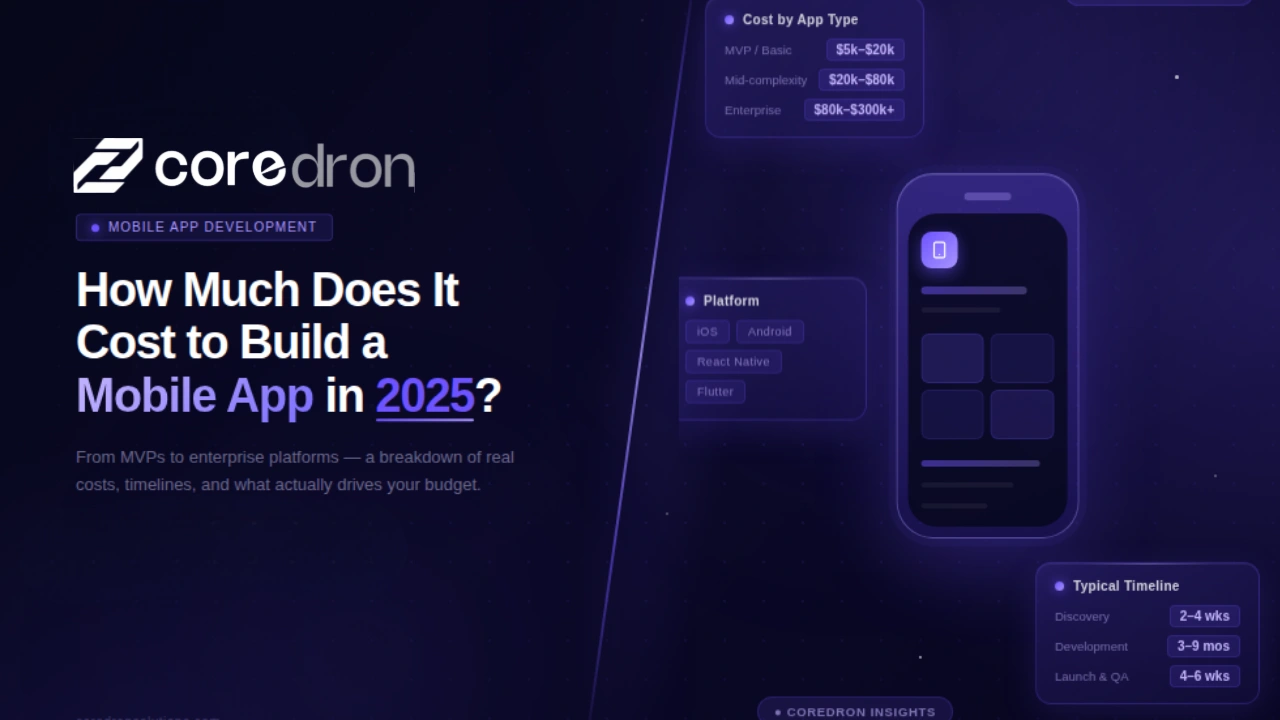
The average mobile app development cost in 2026 ranges from $15,000 to $300,000+, depending on the app’s unique features.
Users can opt for a wide range of features in their apps and pay the price accordingly. A simple app with basic functionality stays on the lower end, while a more advanced product with integrations, real-time features, and scalability requirements naturally attracts higher costs.
According to Clutch, most small to mid-sized app projects fall between $10,000 and $49,999, while complex applications often cross $100,000. The difference mainly comes down to the level of functionality required at launch.
To make this easier to understand, mobile apps are generally grouped into three categories:
- Basic apps ($15,000–$50,000)
Simple features, limited backend, and straightforward design
- Mid-level apps ($50,000–$150,000)
User accounts, API integrations, dashboards, and moderate complexity
- Complex apps ($150,000–$300,000+)
Real-time systems, advanced features, and scalable infrastructure
In practice, most startups and SMEs begin somewhere in the middle. They build a focused version first, then expand based on user feedback and business needs.
That approach tends to control cost early, without limiting long-term growth.
What Factors Affect Mobile App Development Pricing?
Mobile app development pricing is mainly influenced by the app’s complexity and what it needs to handle from the start.
Everything else (platform, design, team) adds to that base. But complexity is usually where costs begin to move.
Complexity
This is where most of the budget goes.
A basic app with limited functionality is relatively straightforward. Once features like real-time updates, integrations, or custom workflows are introduced, the effort increases quickly.
For instance, an app that only displays static content is simple to build. Add user accounts, payments, or live data, and the scope changes entirely.
Platform
Platform decisions can cost more than expected.
Building for iOS and Android separately means maintaining two codebases, two testing cycles, and two sets of updates. That adds time.
Some teams avoid this early on. They launch on one platform, validate demand, and then expand.
Design Requirements
Design is often underestimated at the planning stage.
Basic layouts are faster to implement. Custom interfaces, with transitions, animations, and detailed user flows, take longer. Not dramatically at first, but it adds up.
It also affects how users engage with the app, which becomes important after launch.
Development Team
Who builds the app matters as much as what is being built.
Rates vary widely:
- India: $20–$50 per hour
- Eastern Europe: $40–$80 per hour
- US/UK: $80–$150+ per hour
Lower rates can reduce upfront costs. But experience, communication, and execution quality tend to balance that out over time.
Backend and Integrations
Not every app needs a complex backend. But once it does, costs increase.
Features like:
- Payments
- Real-time syncing
- Third-party integrations
Adding such features requires additional systems behind the app, which adds both development time and infrastructure cost.
Timeline
A timeline is often treated as fixed. It rarely is.
Short deadlines usually require more developers working in parallel. That increases cost. Longer timelines spread the effort, but delay the launch.
Most teams end up adjusting somewhere in between.
How Much Does It Cost to Build Different Types of Apps?
When thinking – ‘how much to build an app,’ you should understand that the cost to build a mobile app varies significantly based on the type of app being developed.
Different categories have varying levels of complexity, feature requirements, and backend needs. That’s why two apps that seem similar on the surface can have very different budgets.
E-commerce Apps – $50,000 to $200,000+ range
E-commerce apps require product listings, payment integration, user accounts, and order management. That’s the baseline.
What increases cost is everything around it: inventory syncing, recommendation systems, or multi-vendor support. Those features tend to expand both development time and backend requirements.
Social Media Apps – $80,000 to $300,000+ range
Social media apps are typically more expensive, often starting at around $80,000 and exceeding $300,000.
The core features (profiles, feeds, messaging) seem straightforward. The complexity comes from how frequently data changes and how quickly it needs to be updated.
Real-time interactions, media uploads, and notifications all add layers that are not immediately visible at the planning stage.
On-Demand Apps- $100,000 to $250,000+ range
On-demand apps, such as ride-hailing or delivery platforms, generally range between $100,000 and $250,000+.
These apps often involve multiple interfaces:
- User app
- Service provider app
- Admin panel
Each part needs to work together in real time. Location tracking, route optimization, and payment handling increase both development and infrastructure costs.
SaaS or Business Apps – $60,000 to $200,000+ range
SaaS and internal business apps usually fall between $60,000 and $200,000+.
They focus more on functionality than visual complexity. Dashboards, reporting systems, and integrations with other tools are common.
The cost here depends less on design and more on how data is structured and managed behind the scenes.
How Does the App Development Process Impact Cost?
The development process directly affects the cost of a mobile app, mainly because each stage requires varying amounts of time, effort, and expertise.
Not every phase carries the same weight. Some are quick and straightforward. Others take longer than expected, especially when changes happen mid-way.
Discovery and Planning
This is where most projects begin, and it often costs between $2,000 and $10,000.
The goal here is to define what the app will include, how it will function, and what its overall scope is. It sounds simple, but skipping or rushing this step usually leads to higher costs later.
Small gaps at this stage tend to show up during development.
Design
Design costs can range from $3,000 to $30,000+, depending on how detailed the interface needs to be.
Basic layouts are quicker to finalize. More refined designs, with custom interactions and multiple user flows, take longer to develop.
Not always obvious at first, but the difference shows during implementation. This stage also shapes how users experience the product after launch.
Development
This is where most of the budget goes. Development typically ranges from $10,000 to $200,000+, depending on features, integrations, and overall complexity.
Frontend and backend work often run in parallel. As features increase, so does coordination between different parts of the system. That’s where timelines and costs start to stretch.
Testing and Launch
Testing and deployment usually cost between $5,000 and $20,000.
This includes fixing bugs, optimizing performance, and preparing the app for release on platforms such as iOS and Android. Some issues only appear at this stage, which is why it’s rarely as quick as planned.
Maintenance and Updates
Maintenance is an ongoing cost, not a one-time expense. Most apps require around 15–20% of the initial development cost annually for updates, performance improvements, and security fixes.
According to Statista, mobile apps continue to see consistent growth in usage and revenue, which means regular updates are necessary to stay competitive.
What Most Guides Don’t Tell You About Mobile App Budget in 2026
Most cost breakdowns focus only on development. That’s only part of the picture.
The actual mobile app budget in 2026 goes beyond the initial build. Ongoing costs, scaling requirements, and post-launch changes tend to have a bigger impact over time.
Ongoing Costs Add Up
Once the app is live, expenses don’t stop. There are recurring costs such as:
- Cloud hosting
- Third-party APIs
- App store fees
- Security updates
Individually, these may seem manageable. Over time, they become a consistent part of the budget.
Scaling Changes the Cost Structure
An app built for a few hundred users behaves very differently from one serving thousands. As usage grows, so do infrastructure requirements.
Performance optimization, server scaling, and data handling all require additional investment. This is usually not a concern in the early stages. It becomes one later.
Delays Are Expensive
Project delays don’t just affect timelines. They affect cost. Extended timelines often mean:
- More development hours
- Additional revisions
- Higher coordination effort
Even a delay of a few weeks can increase the overall cost more than expected.
Cheap Builds Can Lead to Rework
Lower upfront cost does not always mean lower total cost. Some teams start with minimal budgets and basic architecture. It works initially, but as the product grows, limitations begin to show.
At that point, rebuilding parts of the app becomes necessary. That often costs more than building it correctly from the start.
Budgeting Is Not a One-Time Exercise
Planning a mobile app budget is not something that happens once. Requirements change. Features evolve. Market expectations shift.
Most successful teams treat budgeting as an ongoing process rather than a fixed estimate.
How to Reduce Mobile App Development Cost Without Compromising Quality
Reducing mobile app development cost is less about cutting features and more about making better decisions early. Most cost overruns don’t happen because the app is too complex. They happen because priorities are unclear or the scope keeps changing.
- Start with a Focused Scope
Trying to build everything at once increases both cost and risk. A more practical approach is to focus on core features first. This is often referred to as an MVP (minimum viable product), where only essential functionality is developed initially.
It keeps the project manageable and allows room for improvement based on actual user feedback.
- Prioritize What Matters
Not every feature needs to be part of the first release. Some features improve usability. Others are critical to the product’s core function. The difference matters when planning a budget.
Focusing on high-impact features first helps control development effort without affecting the app’s overall value.
- Consider Cross-Platform Development
Building separate apps for iOS and Android can increase cost. Cross-platform frameworks allow a single codebase to be used across both platforms. This reduces development time and, in many cases, simplifies maintenance.
It may not fit every use case, but for many products, it offers a practical balance between cost and performance.
- Choose the Right Development Team
Lower hourly rates can reduce upfront cost, but they don’t always reduce total cost. Experience, communication, and execution quality play a significant role in how smoothly the project progresses.
Delays, rework, or poor implementation can offset any initial savings. The focus should be on long-term value rather than on hourly pricing alone.
- Plan for Iteration
Apps rarely stay the same after launch. User feedback, performance improvements, and new features require ongoing updates.
Planning for these changes early helps avoid sudden budget increases later. This approach also allows the product to evolve without major disruptions.
Conclusion
A single number doesn’t define the mobile app budget in 2026. A set of decisions shapes it:
- What the app needs to do
- How it’s built
- How it evolves over time
For most teams, the difference in cost comes down to clarity. Clear scope, focused features, and the right development approach tend to keep budgets under control. Without that, even simple apps can become expensive.
A realistic mobile app budget is not just about the initial build. It includes planning for iteration, scaling, and ongoing improvements as the product grows.
When approached the right way, app development becomes less about managing costs and more about building something that consistently delivers value.