Introduction
A lot of people walk into software projects with a number already in mind.
"We have around $5,000. What can we build?"
Sounds simple, but that question usually has more than one answer.
Software pricing can vary quite a bit. One business might use that budget to build a small internal tool and get exactly what they need. Another might expect a feature-heavy platform and realize halfway through that the budget disappears much faster than expected.
That’s where expectations often get crossed.
A $5,000 startup software budget is not too small, and it is not unlimited either. It sits somewhere in the middle. Enough to build something useful, but usually not enough to build everything at once.
The real value often comes from deciding what matters first.
In this guide, we’ll break down what businesses can realistically get at this budget level, where the limits usually show up, and a few ways to make that investment work harder without stretching it in the wrong places.
Can You Build Custom Software for $5,000?
The short answer is yes, but the longer answer is that it depends on what you expect the software to do.
A $5,000 budget can build something useful, but it usually works better when the goal is focused. Problems often start when businesses try to fit an entire product roadmap into an early budget.
That’s where the difference between an MVP and a full product becomes important.
An MVP, or minimum viable product, focuses on the core idea. It includes the features needed to test, launch, or solve a specific problem. A full-scale product usually comes later, after feedback, updates, and additional functionality begin shaping the direction.
At this budget level, simpler systems generally make more sense.
Instead of building everything at once, businesses often get better results by prioritizing the functionality that users actually need first.
A few examples that can realistically fit this range include:
- Internal dashboards for tracking operations or reports
- Booking and appointment systems
- Lightweight CRM tools with core workflows
- Basic mobile app MVPs with limited features
- Workflow or automation software for repetitive tasks
The key is not trying to build the final version immediately. Smaller first versions often give businesses something equally valuable: real feedback.
What Is Typically Included in a $5,000 Software Project?
A lot of businesses hear the term "custom software" and immediately picture a large product with dozens of screens and features.
At this budget level, it usually looks different.
Most projects in the $5,000 range focus on getting the first usable version into place. Enough functionality to solve a problem, test an idea, or start using the product without trying to build everything at once.
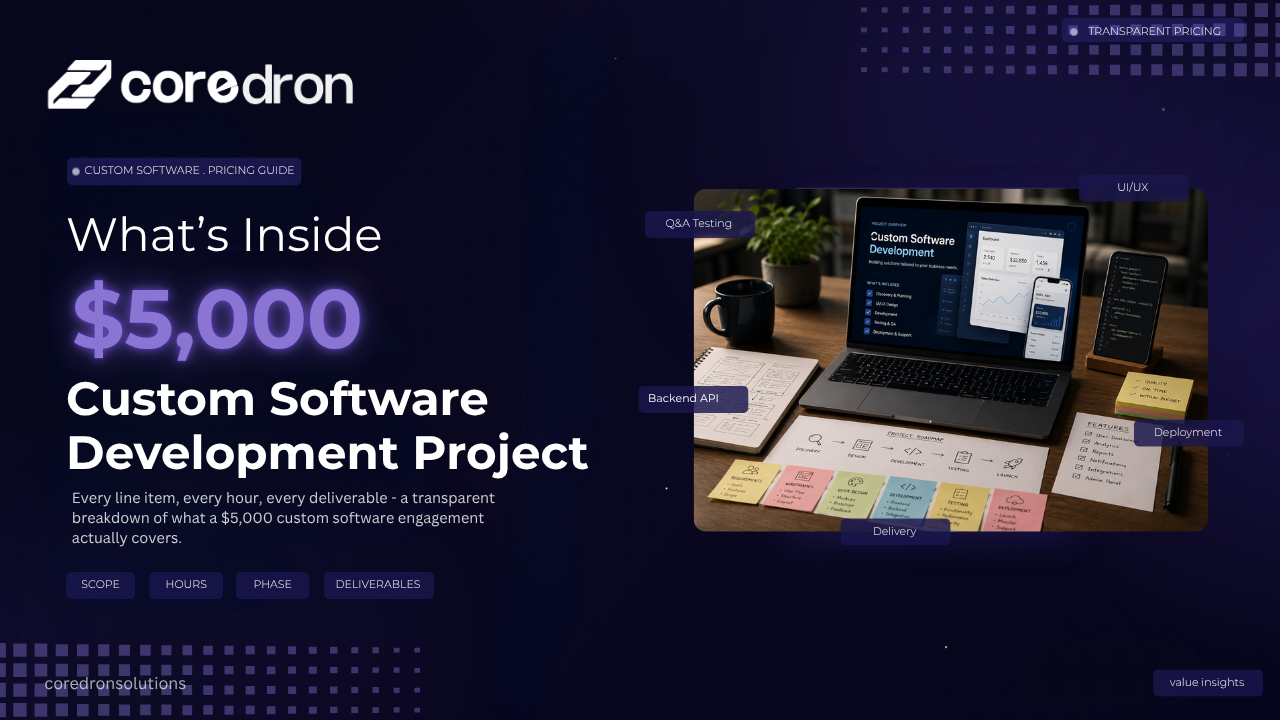
Core Discovery & Planning
Projects usually begin with conversations before development. There’s some time spent understanding requirements, identifying must-have features, and deciding what belongs in version one. This part matters because small changes early can prevent larger problems later.
UI/UX Design
The design process at this stage is generally straightforward. Teams often create simple wireframes and practical layouts that help users move through the product easily. The focus stays on clarity and usability rather than heavily customized visuals.
Development
This is the part where things start coming together. Depending on the project, that could mean building login functionality, setting up an admin area, connecting key workflows, and developing the components needed for the product to function.
Quality Assurance (QA)
No product launches perfectly on the first try. Testing typically includes verifying key functions, fixing noticeable issues, and ensuring users do not encounter obvious problems when using the application.
Deployment & Launch
Once the product is ready, attention shifts toward getting it live. That often includes deployment help, basic setup guidance, and support during launch so businesses are not left figuring everything out on their own.
Phase-by-Phase Cost Breakdown
One reason software pricing feels confusing is that the budget is not allocated to a single bucket. It usually gets distributed across different stages of the project.
For a $5,000 custom software project, some phases naturally take a larger share than others. Development tends to consume most of the budget, while planning, testing, and launch support take smaller portions.
| Phase | Typical Price Range | What’s Included |
| Discovery & Planning | $500–$750 (10–15%) | Requirement discussions, feature mapping, project scope definition |
| UI/UX Design | $500–$750 (10–15%) | Wireframes, basic interface layouts, and user flow planning |
| Development | $2,500–$3,000 (50–60%) | Core functionality, frontend and backend setup, workflows |
| QA & Testing | $500–$750 (10–15%) | Functional testing, bug fixes, cross-device checks |
| Deployment & Launch | $250–$500 (5–10%) | Deployment support, server guidance, launch assistance |
A small thing worth remembering here: these numbers are not fixed.
A project with heavier backend development may push more budget toward implementation. A stronger design focus may shift toward UI/UX design.
The split changes, but the idea usually stays the same. More complexity in one area often means less room somewhere else.
What You Usually Won’t Get at This Budget
Being realistic about budget limits is just as important as talking about what is included.
A lot of projects run into trouble because expectations outpace the budget. A $5,000 investment can absolutely build something useful, but there are areas where the limits start becoming visible.
Enterprise-Level Architecture
Large systems usually involve more planning behind the scenes than people expect. Things like high-scale infrastructure, advanced security layers, and long-term scalability planning often sit outside this budget range because they require additional time and engineering effort.
Complex Integrations
Integrations can look simple on the surface and still require significant work underneath. Projects involving ERP platforms, custom API integrations, or several third-party systems usually add more complexity than expected.
Advanced AI or Automation
AI has become part of many products, but custom AI systems are a different conversation. Machine learning workflows, predictive analytics, and highly customized automation software often require larger budgets and additional development resources.
Large Feature Sets
Trying to build too much at once is where many budgets start getting stretched. Multi-role systems, marketplace-style products, and applications with layered workflows usually need more planning and development time.
Long-Term Dedicated Teams
A $5,000 budget typically supports a defined project rather than a full product department. Ongoing sprint teams, larger engineering groups, and long-term development resources generally sit in a different budget category.
That doesn’t make a smaller budget ineffective. It simply means the first version often works best when the focus stays on solving one problem well instead of solving everything at once.
Realistic Software Projects You Can Build for $5,000
A $5,000 budget may not cover a large-scale product with every feature planned for the future, but it can still build something useful.
The key is keeping the project focused. Businesses often get more value from solving one problem properly than trying to solve ten at the same time.
- Internal business tools:
Many companies build simple internal tools to reduce manual work. This could be a dashboard for tracking reports, managing employee tasks, handling approvals, or organizing daily operations.
- MVP startup platforms:
For startup founders, a smaller budget is often used to test an idea before making a larger investment. Instead of building the complete product immediately, the first version usually includes only the features needed to collect early feedback.
- Admin dashboards:
Dashboards remain a common choice because they help businesses centralize information. They can be used for customer data, sales activity, reporting, or operational tracking without creating complicated systems around them.
- Scheduling systems:
Booking and scheduling tools are practical projects in this range. Appointment management, calendar-based workflows, and reservation systems often fit better when the feature set stays limited.
- Workflow automation apps:
Businesses spend a surprising amount of time on repetitive work. Smaller automation software projects can help reduce manual processes by streamlining workflows.
- Lightweight SaaS MVPs:
Not every SaaS product begins as a large platform. Many start with a small feature set, a few workflows, and a basic user experience. The first version is usually built to validate demand before adding more complexity later.
How to Stretch a $5,000 Software Budget Further
A fixed budget does not always mean fixed results. Two businesses can spend the same amount and end up in very different situations.
One launches a usable product and starts collecting feedback. The other spends months building features users may never touch.
The difference often comes down to early decisions like:
Start with an MVP
A smaller budget works better when attention stays on the essentials. Instead of trying to launch a complete product, focus on the features users need to perform the main action.
For a booking platform, that may simply mean account creation, scheduling, and confirmations. Everything else can wait.
Avoid Overbuilding Early
It is easy to plan for future situations that may never happen. Advanced dashboards, complex user roles, or features intended for a much larger user base often sound useful during planning.
But adding too much too early can stretch the budget without adding immediate value. Build for today's problems first.
Use Existing Services
Building everything from the ground up usually takes more time and costs more money. Existing tools can reduce that effort.
Payment systems like Stripe, platforms like Firebase, or authentication providers can handle common functionality without requiring custom development for every feature. That leaves more room for the parts that actually make the product unique.
Choose Cross-Platform or Web First
Developing separate products for different platforms can quickly increase effort. Many startups begin with cross-platform development or web application development because it reduces duplicate work and speeds up launch timelines.
For early-stage products, getting to market often matters more than building everywhere at once.
Work with a Product-Focused Team
Some development teams build exactly what is specified in the requirements document. Others ask questions.
Teams that understand business goals usually help identify unnecessary features, challenge assumptions, and keep the project focused on outcomes rather than feature count alone. That can save far more than the initial budget difference.
This version gives more substance while still maintaining human rhythm and search intent.
Pricing Model Comparison
The final project cost is influenced by more than features and technology. The pricing model also changes how the project is managed, how flexible the process becomes, and how predictable the budget stays.
Different models work better for different situations.
| Pricing Model | Best for | Risk Level | Budget Predictability |
| Fixed Price | Project with a clear scope | Low to moderate | High |
| Hourly Billing | Projects with a clear scope | Moderate | Medium |
| Dedicated Team | Long-term product development | Moderate to high | Low |
Fixed Price
Fixed-price projects usually work well when the requirements are already defined.
Smaller applications, MVPs, or products with a clear software development scope often fit this model because businesses know what they want before development starts.
The advantage is predictability. The trade-off is flexibility. Changes later in the project can increase both cost and timelines.
Hourly Billing
Hourly models leave more room for changes along the way.
This can help when requirements are still evolving or when businesses are using an agile development approach. The challenge is that the scope can shift over time, making total costs harder to estimate early.
Dedicated Team
Dedicated teams are generally used for products expected to grow over a longer period.
Instead of hiring for a single project, businesses work with an ongoing team handling development, updates, and future improvements. For many smaller projects, this model usually sits beyond a $5,000 startup software budget, but it becomes more common as products expand.
Common Mistakes Businesses Make at This Budget
A smaller budget usually leaves less room for mistakes. A few early decisions can affect timelines, priorities, and sometimes the product itself. Some patterns show up more often than others.
Here’s a closer look at some common mistakes businesses make with this budget:
a. Expecting enterprise-scale products:
A $5,000 project can build something useful, but it generally will not support enterprise-level complexity from day one.
Trying to fit large infrastructure, advanced workflows, and dozens of features into an early build often creates unrealistic expectations.
b. Prioritising too many features:
This happens quite often with early products. Everything starts feeling important, and the feature list keeps growing. Eventually, the budget gets spread across too many areas, and the core idea loses attention.
c. Ignoring maintenance costs:
Development does not completely stop after launch. Updates, fixes, small improvements, and software maintenance usually become part of the process later. Ignoring that can create budgeting surprises.
d. Choosing the cheapest vendor blindly:
Lower pricing can feel like an easy decision at first. But there are situations where cheaper development ends up creating higher costs later through delays, rework, or quality issues.
e. Skipping discovery and planning:
Many businesses want to move straight into development. The problem is that unclear requirements often create bigger issues later. Spending time on planning usually prevents confusion once work begins.
How to Choose the Right Development Partner
The development partner matters almost as much as the budget itself. Two teams can receive the same requirements and still deliver very different results. Technical skills matter, but they are not the only thing worth paying attention to.
Here’s a closer insight into how to choose the right development partner:
Clear communication
Pay attention to how conversations happen early on:
Slow replies, vague explanations, or inconsistent updates before the project starts rarely improve later.
Scope transparency:
Good teams usually talk openly about what fits the budget and what does not. Clear expectations around features, timelines, and limitations help avoid confusion once work begins.
Product thinking:
Some teams focus only on completing tasks. Others ask questions about users, business goals, and long-term plans. That difference becomes noticeable as products evolve.
Portfolio relevance:
A portfolio matters, but relevance matters more. A company that has built products similar to yours may understand the challenges more quickly than a team with unrelated projects.
Honest expectation setting:
The strongest partners do not promise everything immediately. They usually discuss trade-offs, ask difficult questions, and explain limitations early on, rather than waiting until development has already started.
Conclusion
A $5,000 software budget can absolutely turn into something useful.
The difference usually comes from expectations. Businesses that try to fit an entire product vision into an early budget often struggle. The ones that focus on solving a specific problem tend to move faster and learn more from the process.
That is why scope matters so much. Starting with a smaller version allows businesses to launch sooner, gather feedback, and understand what users actually need before investing further.
Build lean first. Improve later.
While the budget plays a role, the development partner matters too. The right team can help prioritize features, avoid unnecessary work, and make limited resources go much further.