For many small and mid-sized businesses, custom software is no longer a long-term plan. It’s something they end up needing much earlier than expected.
Spreadsheets start breaking. Tools stop talking to each other. Workarounds become part of daily operations.
That’s usually when the conversation shifts from “Do we need custom software?” to “Who should build it?”
Spending in this space has been growing steadily. According to Statista, global investment in digital transformation is expected to exceed $3 trillion, with more SMBs moving toward tailored systems rather than generic tools.
India often comes up as a natural option at that point. The pricing works, the talent pool is large, and there’s no shortage of companies offering development services. Industry data from NASSCOM also reflects how deeply the country is involved in global software delivery.
But that’s where the problem starts.
Too many options, and not all of them built for SMBs.
Some teams are set up for large enterprise projects. Others focus on quick delivery but struggle to scale systems. For a growing business, those differences show up faster than expected.
This list looks at companies from that lens. Not the biggest names by default, but teams that tend to work better for SMBs trying to build something practical and sustainable.
What Are the Best Custom Software Development Companies in India for SMBs?
There isn’t a single company that works best for every SMB. The answer usually depends on what the business is trying to solve right now.
A team building its first internal system has very different needs compared to one replacing legacy software or integrating multiple tools. The gap shows up quickly once development starts.
Most SMBs tend to look for a few things:
- A setup that doesn’t lock them into rigid contracts
- Teams that can work with evolving requirements
- Clear communication without too many layers
- Systems that can scale without being overbuilt
Cost still matters, but it’s rarely the only factor. According to Clutch, businesses usually rank communication, reliability, and technical understanding among the top criteria when choosing a development partner.
That’s why this blog doesn’t just focus on well-known companies. It leans toward teams that SMBs can realistically work with, especially when flexibility and long-term usability matter more than size alone.
How This List Was Evaluated
There are plenty of lists that rank companies based on size or brand recognition. That approach doesn’t always help SMBs.
The focus here is slightly different. The companies were evaluated from a practical standpoint, based on how well they fit real business needs rather than on how large or well-known they are. A few factors made the difference.
SMB Fit
Some companies are built for enterprise-scale systems. That often comes with heavy processes and higher costs.
For this list, preference was given to teams that work well with smaller and mid-sized businesses. That usually means more flexibility and fewer layers in communication.
Pricing and Flexibility
Budget plays a role, but it’s not just about the lowest rate. The ability to adjust scope, change priorities, or scale the team up and down matters just as much. SMBs rarely have fixed requirements from day one.
Ability to Scale
A system that works today should not become a limitation six months later. Companies were considered based on whether they could support growth without needing a complete rebuild. This includes both technical capability and process maturity.
Communication and Process
This is the point at which most projects either do well or do not. Teams that write things down and share what is going on often, and are open about what they are doing, tend to get results that are easier to predict.
The people at Clutch say that problems communicating with each other are among the reasons projects take longer than they should.
Real-World Relevance
Not every company on a “top list” is practical for SMBs. The final selection leans toward companies that businesses can realistically engage with, both in terms of cost and collaboration.
This isn’t a perfect system, but it reflects how most SMBs actually evaluate development partners when the decision needs to be made.
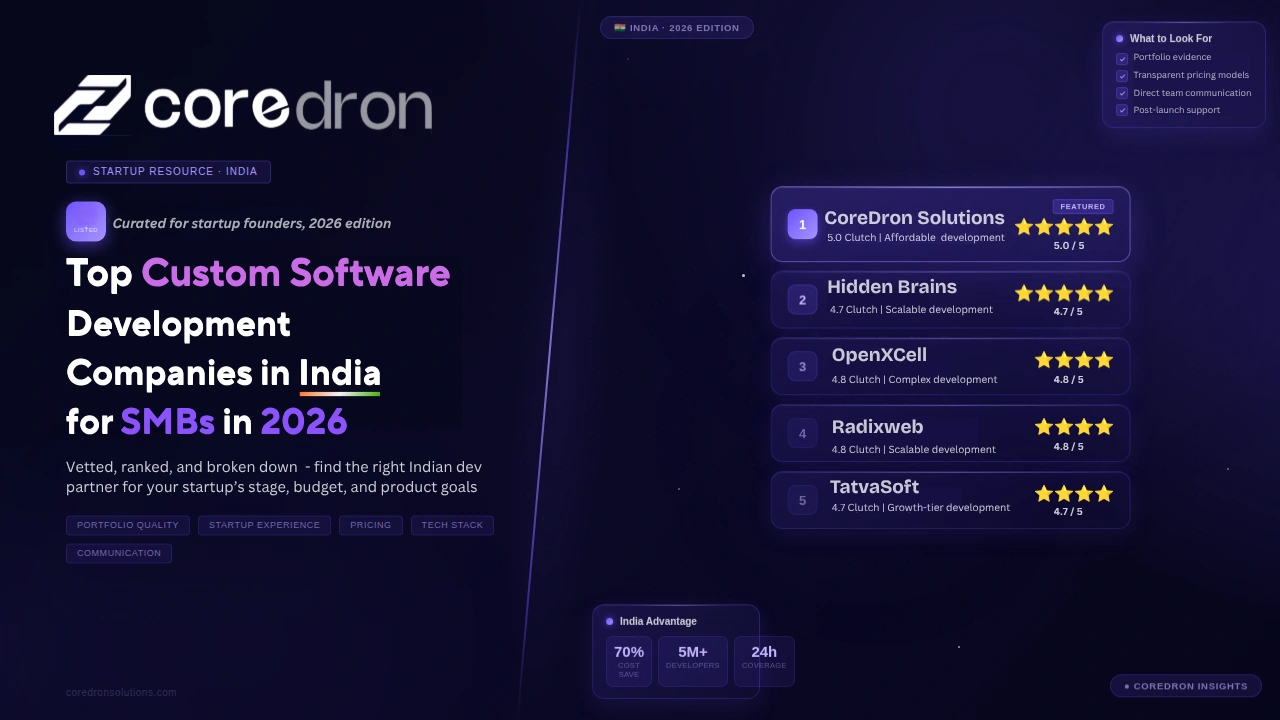
Top Custom Software Development Companies in India for SMBs (2026)
There isn’t a perfect order that works for every business. What matters more is how each company fits the stage and type of work.
The list below brings together teams that SMBs tend to consider when they need something practical rather than overbuilt. Some are more flexible. Some are stronger on process. The differences show up once you look a bit closer.
1. Hidden Brains – Flexible Development for Cost-Conscious SMBs
At a Glance
| Aspect | Details |
|---|---|
| Founded | 2006 |
| Clutch Rating | 4.7+ |
| Hourly Range | $20 – $50 / hr |
| Minimum Budget | $10,000+ |
| Team Size | 700+ |
Hidden Brains is often considered when the goal is to get something built without stretching the budget too far. The team works on a range of projects, making it easier for SMBs to start small and expand later.
What stands out is the flexibility. Engagement models are not too rigid, and that helps when requirements are still taking shape.
- Best for: Budget-conscious SMBs
- Stage fit: Early to mid-stage
- Strength: Flexible engagement and pricing
- Consideration: Output may vary across teams
2. OpenXcell – Practical Software Development for Early-Stage SMB Needs
At a Glance
| Aspect | Details |
|---|---|
| Founded | 2009 |
| Clutch Rating | 4.8+ |
| Hourly Range | $18 – $40 / hr |
| Minimum Budget | $10,000+ |
| Team Size | 500+ |
OpenXcell is usually brought in when speed matters. A lot of their work sits around early-stage builds, where the goal is to move from idea to something usable without too much delay.
This works well for SMBs testing a process or building their first system.
- Best for: MVPs and early builds
- Stage fit: Idea to early-stage
- Strength: Fast execution cycles
- Consideration: May need scaling support later
3. CoreDron Solutions – Structured Custom Software Development for Affordable SMB Growth
At a Glance
| Aspect | Details |
|---|---|
| Founded | 2021 |
| Clutch Rating | 5.0+ |
| Hourly Range | $25 – $100 / hr |
| Minimum Budget | $5,000+ |
| Team Size | 10+ |
CoreDron stands out for a slightly different reason compared to most development teams. The focus is not just on building features, but on understanding how the business operates before development begins.
From a pricing standpoint, the positioning is closer to the mid-range than to the premium enterprise segment. This makes it more accessible to SMBs that want structured development without committing to large upfront budgets.
- Best for: SMBs moving from manual to structured systems
- Stage fit: Early to mid-stage growth
- Strength: Clear process, practical execution, cost balance
- Consideration: Requires upfront alignment before development starts
4. Radixweb – Reliable Development for SMB and Mid-Market Projects
At a Glance
| Aspect | Details |
|---|---|
| Founded | 2000 |
| Clutch Rating | 4.8+ |
| Hourly Range | $25 – $150 / hr |
| Minimum Budget | $25,000+ |
| Team Size | 650+ |
Radixweb sits somewhere in the middle. Not too heavy, not too lightweight. It’s often considered by SMBs that already have a defined idea of what they want to build.
For SMBs without a fully structured system in place, that clarity makes a noticeable difference.
- Best for: Defined-scope projects
- Stage fit: Mid-stage SMBs
- Strength: Balanced delivery approach
- Consideration: Less suited for unclear requirements
5. TatvaSoft – Balanced Development with Consistent Delivery
At a Glance
| Aspect | Details |
|---|---|
| Founded | 2001 |
| Clutch Rating | 4.7+ |
| Hourly Range | $25 – $150 / hr |
| Minimum Budget | $50,000+ |
| Team Size | 1000+ |
TatvaSoft is known for steady, consistent delivery across projects. It doesn’t lean heavily toward experimentation, but it handles execution well.
- Best for: Stable builds
- Stage fit: Mid-stage projects
- Strength: Predictable delivery
- Consideration: Less flexibility for changes
6. SoluLab – Modern Tech Solutions with Scalable Architecture
At a Glance
| Aspect | Details |
|---|---|
| Founded | 2014 |
| Clutch Rating | 4.9+ |
| Hourly Range | $25 – $100 / hr |
| Minimum Budget | $10,000+ |
| Team Size | 500+ |
SoluLab is often the choice for projects that’re not your average software projects. The team at SoluLab works on a range of areas, including artificial intelligence, blockchain, and software-as-a-service platforms. This makes SoluLab a good fit for products that need to do more than the basics.
For medium-sized businesses working on highly technical projects or planning to grow quickly, SoluLab’s experience can be really helpful. It means that systems can be designed to grow from the start, without having to be changed later on.
- Best for: Tech-driven products
- Stage fit: Growth-stage SMBs
- Strength: Modern tech stack expertise
- Consideration: May be more than needed for simple builds
7. ValueCoders – Flexible Hiring Models for Growing SMB Teams
At a Glance
| Aspect | Details |
|---|---|
| Founded | 2004 |
| Clutch Rating | 4.7+ |
| Hourly Range | $50 – $200 / hr |
| Minimum Budget | $25,000+ |
| Team Size | 675+ |
ValueCoders is usually the choice for medium-sized businesses that want to add to their own team rather than handing over a whole project to someone else. ValueCoders has ways of hiring people that let businesses decide how to use the people they hire.
This approach is good for teams that already have a plan in place but need help getting things done faster. It also gives teams the freedom to make changes as their workload changes over time. ValueCoders is an option for teams that need this kind of flexibility with ValueCoders.
- Best for: Team extension
- Stage fit: Early to growth-stage
- Strength: Flexible hiring models
- Consideration: Requires internal coordination
Quick Comparison of Custom Software Development Companies for SMBs
If you’re scanning options, this is where the differences become easier to spot.
Not every company here is built for the same kind of work. Some are better for early-stage builds. Others are more suited for structured systems or long-term scaling.
| Company | Best for | Strength | Consideration |
|---|---|---|---|
| Hidden Brains | Budget-conscious builds | Flexible pricing | Output can vary |
| OpenXcell | MVP and quick builds | Fast turnaround | Limited scaling depth |
| CoreDron | Workflow-based systems | Structured execution | Needs upfront clarity |
| Radixweb | Defined projects | Balanced delivery | Less flexible early |
| TatvaSoft | Stable builds | Consistency | Less adaptive |
| SoluLab | Tech-heavy platforms | Modern stack expertise | Overkill for simple needs |
| ValueCoders | Team extension | Flexible hiring | Needs internal management |
Looking at it this way usually makes the choice clearer.
If the goal is speed, the options shift in one direction. If the focus is on structure or long-term scalability, the priorities change.
There’s no single “best” company here. It depends on what the business actually needs right now, and how much that is likely to change over time.
How to Choose the Right Custom Software Development Company for SMBs
There isn’t a single way to evaluate every company. What usually helps is breaking the decision into a few practical considerations.
#1. Match the Company to Your Current Stage
Not every team works the same way across all stages.
- If the system is still an idea or loosely defined, flexibility matters more than structure. Teams that can adapt quickly tend to work better here.
- If the scope is clearer, a more structured team helps keep development on track and reduces confusion later.
Choosing a company that fits the current stage avoids unnecessary friction during execution.
#2. Look Beyond Hourly Rates
Cost is a deal, but it’s not the whole story. First of all, low rates can feel nice. Real-world projects that need extensive fixing or explanation often end up costing more in the long run.
Clutch also notes that when choosing a development partner, businesses tend to prioritize communication, reliability, and expertise – not price. They want to work with someone who can do the job properly.
#3. Evaluate Communication Early
Communication issues rarely show up in the beginning. They appear once work starts.
Look for teams that:
- Explain things clearly
- Share regular updates
- Document decisions properly
This reduces delays and keeps expectations aligned as the project progresses.
#4. Understand How Flexible the Process Is
SMB projects don’t always follow a fixed plan:
- Requirements change
- Priorities shift
- The company you choose should be able to handle that without slowing everything down.
Rigid processes can create delays, while flexible ones help keep momentum.
#5. Check Scalability from a Practical Perspective
Scalability is often discussed, but not always in a useful way. The question is not whether the system can handle massive scale.
It’s whether it can grow without needing to be rebuilt too soon. A good development partner plans for that early, even if the initial version is simple.
#6. Align on Working Style
Different companies work in different ways. Some expect more involvement from the client. Others take a more independent approach.
Understanding this early helps avoid confusion later. The right fit depends on how much control and visibility the business wants during development.
Most of these factors are straightforward, but they tend to make a noticeable difference once the project is underway.
Common Mistakes SMBs Make When Choosing a Development Company
Most problems don’t start during development. They begin much earlier, often at the selection stage. A few patterns show up repeatedly.
#1. Choosing Based on Cost Alone
It’s an easy trap.
- Lower rates look attractive upfront
- But they often come with trade-offs in communication or quality
- Delays and rework can increase the total cost later
The initial saving doesn’t always carry over throughout the project.
#2. Starting Without a Clear Direction
Not every detail needs to be defined, but some clarity is necessary.
- No defined scope leads to constant changes
- Priorities shift without alignment
- Timelines become harder to manage
Even a basic structure helps keep the project on track.
#3. Ignoring Communication Fit
Technical skills matter, but they’re only part of the picture.
- Misunderstandings slow progress
- Lack of updates creates uncertainty
- Small issues take longer to resolve
This is one of the most common reasons projects drift over time.
#4. Trying to Build Everything at Once
It’s tempting to include every idea in the first version.
- More features increase complexity
- Development takes longer
- Testing becomes harder
A focused version is usually easier to build and improve later.
#5. Not Thinking About What Comes Next
Some decisions are made only for the initial build.
- No plan for scaling
- Limited support after launch
- Difficulty adding new features later
This usually results in the business switching teams. Rebuilding parts of the system.
Most of these mistakes can be avoided. They really come down to being clear about things, having expectations, and picking a partner who fits how the company actually operates.
Conclusion
No single company on this list is “the one.”
Most SMBs figure it out only after a few conversations. One team feels easier to talk to. Another feels too structured. Sometimes the cheaper option ends up costing more later.
That’s usually how the decision gets made.
India gives you options. That’s the advantage. It’s also the part that makes it confusing.
The list helps narrow things down. The actual choice depends on what your setup looks like right now, not what looks best on paper.