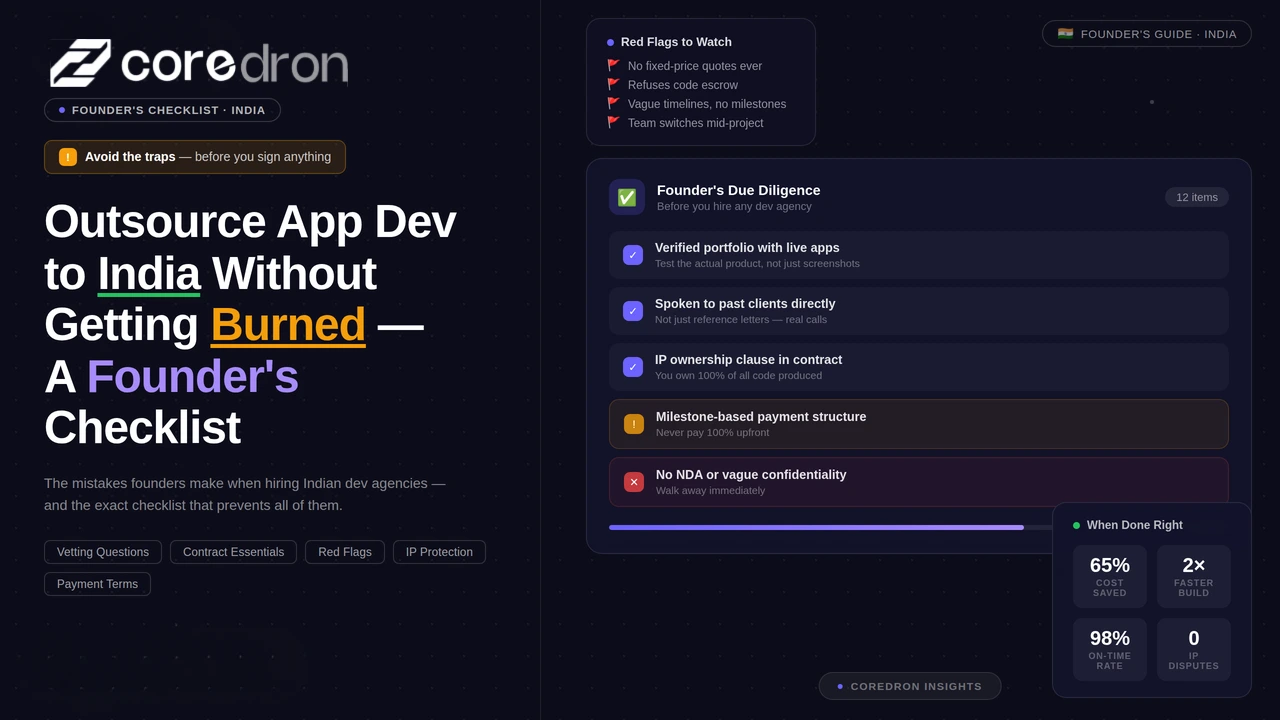
Quick Answer: How to Outsource Mobile App Development to India Safely
Outsourcing mobile app development to India can reduce development costs by 40–60% while giving startups access to large engineering teams and faster MVP delivery. However, the biggest risks include poor communication, weak code quality, hidden outsourcing layers, missed deadlines, and unclear IP ownership.
To outsource safely, founders should:
- Verify technical expertise through real case studies
- Start with a paid discovery phase
- Define milestones and deliverables clearly
- Ensure source code and IP ownership are documented
- Avoid choosing vendors based only on low pricing
- Prioritize teams with strong communication and product thinking
The safest outsourcing partnerships usually come from transparent agencies that focus on long-term scalability rather than short-term delivery alone.
Introduction
A founder hires an overseas app development team after two impressive sales calls. The pricing looks reasonable, the timelines feel aggressive, and everything sounds under control.
A few months later, the project is delayed, communication has become inconsistent, and the codebase is already creating problems.
Unfortunately, this is not rare.
India remains one of the largest software outsourcing destinations in the world, with the IT outsourcing industry generating well over $200 billion annually. For startups, the appeal is obvious. Development costs are often 40–60% lower compared to hiring local engineering teams in the US or parts of Europe.
According to Deloitte’s Global Outsourcing Survey, businesses are increasingly outsourcing not just for cost reduction, but for scalability, operational flexibility, and faster innovation cycles.
That cost advantage is real, but so is the risk.
A lot of founders assume that outsourcing problems come from geography. Most of the time, they come from poor vetting, weak communication, or choosing a team that looked good in sales conversations but struggled during execution.
That’s where things get expensive. Missed deadlines are frustrating. Rebuilding unstable software six months later is worse.
This guide is built for founders trying to avoid that situation.
Not a generic “why outsource to India” article. A practical checklist for choosing the right mobile app development partner, spotting red flags early, protecting your IP, and avoiding the mistakes that usually show up after the contract is signed.
Why Startups Outsource Mobile App Development to India
For most startups, outsourcing begins with one thing: budget pressure.
Hiring an in-house mobile app team in the US, UK, or parts of Europe gets expensive quickly. Salaries, infrastructure, recruitment, and onboarding. Early-stage startups usually can’t afford to build large engineering teams immediately.
That’s one reason India became a major outsourcing hub in the first place. But cost is no longer the only factor.
Access to Large Engineering Talent
India produces a massive number of software engineers every year, which gives startups access to a wide talent pool across:
- iOS development
- Android development
- Flutter and React Native
- backend systems
- DevOps and cloud infrastructure
This makes it easier to find teams that can move quickly without having to build everything internally.
Faster MVP Development
Startups care about speed. A delayed launch can affect fundraising, user feedback, and market timing. Outsourcing helps founders start development sooner rather than spending months hiring internally.
Many startups outsource specifically to accelerate MVP delivery and validate ideas earlier.
Lower Operational Costs
The cost difference is still significant. Depending on complexity, outsourcing app development to India can reduce costs by roughly 40–60% compared to hiring equivalent local teams in Western markets. For early-stage startups, that difference extends the runway. And runway matters.
According to Statista, India continues to remain one of the most cost-efficient global software outsourcing destinations, especially for startups building MVPs and scalable SaaS products.
Better Flexibility for Scaling
Building internally is slower to adjust. Outsourced teams make it easier to scale development up or down depending on the product stage. Some startups begin with a small dedicated team, then expand once the product gains traction. That flexibility is difficult to replicate with full in-house hiring early on.
But here’s the part founders miss:
Lower cost does not automatically mean lower risk.
Some outsourcing partnerships work extremely well. Others create technical debt that becomes expensive later.
The difference usually comes down to:
- How carefully the partner was vetted
- How clearly expectations were defined
- Whether the agency thinks beyond just writing code
That’s the part most founders discover too late.
The Biggest Risks Founders Face When Outsourcing
Most outsourcing failures don’t happen because the developers were incapable. They happen because the wrong expectations were set early, and the problems stayed hidden until the project was already moving.
That’s why founders need to understand the risks before signing anything.
#1. Poor Communication:
This is usually the first warning sign. Updates become vague, timelines shift without explanation, and simple discussions start taking too long. In outsourced projects, communication gaps create bigger problems than technical mistakes. If expectations are unclear early on, delays become almost inevitable.
Research from the Project Management Institute (PMI) shows that ineffective communication is one of the leading contributors to software project failure.
#2. Hidden Outsourcing Layers:
Some agencies don’t actually build the product themselves. They win the client, then quietly subcontract the work elsewhere. Founders think they hired one team, but the project is being handled by people they’ve never spoken to. That often leads to inconsistent quality and weak accountability.
#3. Weak Code Quality:
An app may look polished on the surface while the backend is unstable underneath. Poor architecture decisions usually don’t show up during demos. They appear later when the product starts scaling, new features are added, or performance issues begin. By then, fixing the code becomes expensive.
McKinsey & Company estimates that technical debt can account for up to 40% of the value of a company’s technology estate when poor engineering decisions compound over time.
#4. Missed Deadlines:
Startup timelines matter more than most agencies realize. A delayed release can affect investor conversations, customer onboarding, or product validation. And in outsourcing projects, delays often occur because the scope, milestones, or responsibilities were never properly defined at the outset.
#5. No Scalability Planning:
Some teams build only for launch day. There’s little thought around future traffic, integrations, or product growth. The app works initially, but starts breaking as usage increases. That usually leads to partial rebuilds earlier than expected.
#6. Lack of Post-launch Support:
Launching the app is not the end of development. Bugs appear. Features evolve. Infrastructure needs attention. Some outsourcing teams disappear once deployment is complete, leaving startups without long-term support when issues show up.
#7. IP Ownership Confusion:
This gets overlooked surprisingly often. Founders assume they automatically own the code. Sometimes the contract says otherwise. In other cases, access to repositories, infrastructure, or design assets remains with the agency.
That becomes a serious problem later. What most failed outsourcing projects have in common: The warning signs were usually visible early. Founders just moved too fast to notice them.
Founder’s Checklist for Outsourcing Mobile App Development to India
Most outsourcing mistakes happen before development even starts. Not because founders are careless. Usually, because everything looks fine during the sales process. That’s why having a proper vetting checklist matters.
- Verify Technical Expertise Properly:
Don’t stop at portfolios, feel free to ask the right questions, like:
- Ask what technologies the team actually specializes in.
- How they handle scalability.
- What architecture decisions have they made in previous apps?
A good agency should be able to explain technical decisions clearly without hiding behind jargon.
- Ask For Real Case Studies, Not Just App Screenshots:
A polished UI doesn’t tell you much. What matters is:
- What problem did the app solve?
- How the product scaled
- What challenges came up during development
Founders should look for execution quality, not just visual design.
- Speak Directly With The Development Team:
Sometimes the sales team sounds excellent, but the actual developers remain invisible. That’s risky.
You should know who is building the product, how they communicate, and whether they actually understand the business requirements.
- Start With A Paid Discovery Phase:
Jumping directly into full development creates unnecessary risk. A smaller discovery or planning phase helps evaluate:
- Communication quality
- Technical thinking
- Project understanding
- Delivery process
It’s one of the safest ways to test a partnership early.
- Define Deliverables Clearly:
Vague scopes create expensive misunderstandings later. Milestones, timelines, feature lists, responsibilities, and acceptance criteria should all be documented clearly before development begins. The clearer the scope, the fewer surprises later.
- Clarify Communication Structure Early:
Founders should know:
- Who manages the project?
- How often do updates happen
- What tools are used
- How issues are escalated
Weak communication usually becomes visible very early if you pay attention.
- Protect Your Ip And Source Code Ownership:
Never assume ownership is automatic. Contracts should clearly define:
- Source code ownership
- Repository access
- Infrastructure access
- NDA terms
- Post-project transfer rights
This is one area where shortcuts become dangerous.
- Ask About Post-Launch Support:
A good launch does not guarantee long-term stability. Ask what happens after deployment:
- Bug support
- Updates
- Scaling assistance
- Maintenance response times
Some agencies treat launch day as the finish line. Strong partners don’t.
- Don’t Choose Based Only On Pricing:
Cheap projects often become expensive rebuilds. Very low pricing usually means compromises somewhere:
- Inexperienced developers
- Rushed delivery
- Poor QA
- Unstable architecture
The cheapest proposal is rarely the safest decision.
According to Clutch research, businesses prioritize communication quality, reliability, and technical expertise over hourly pricing when evaluating development partners.
- Look For Product Thinking, Not Just Development:
The best outsourcing partners don’t simply say yes to every feature request. They ask questions:
- Challenge weak assumptions.
- Think about scalability,
- UX, and business impact.
That mindset matters far more than founders realize early on.
What does this checklist really do?
It doesn’t eliminate all outsourcing risk. But it helps founders avoid the mistakes that usually end up costing the most later.
Red Flags That Signal a Bad Outsourcing Partner
Most bad outsourcing experiences don’t begin with obvious disasters. They usually begin with small warning signs that founders ignore because they’re excited to move quickly. That’s why spotting red flags early matters.
Here’s a closer look at some red flags that signal a bad outsourcing partner:
#1 Unrealistically Low Pricing:
If one proposal is dramatically cheaper than everyone else, there’s usually a reason. Sometimes the agency underestimates the work just to win the project.
Other times, corners are cut later through weaker QA, junior developers, or rushed delivery. Cheap development often becomes expensive technical debt later.
#2 Saying “Yes” To Everything Immediately:
Strong development teams ask questions. Weak ones agree too quickly. If an agency promises every feature, every timeline, and every request without challenging anything, that’s usually not expertise.
It’s sales behavior – good partners push back when something doesn’t make sense.
#3 No Proper Discovery Process:
Jumping directly into development without understanding the product is risky. A serious agency usually spends time discussing:
- Business goals
- Workflows
- User behavior
- Scalability
- Technical constraints
If discovery feels rushed, execution usually suffers later.
#4 Weak Communication Early On:
Founders should pay attention to communication before signing the contract. Slow replies, vague answers, inconsistent updates, or unclear ownership often get worse once development begins. Projects rarely become more organized after kickoff.
#5 No Discussion Around Scalability:
Some agencies focus only on getting the app live quickly. But founders should ask:
- How the backend scales
- How future integrations are handled
- What happens when traffic increases
If scalability never comes up in conversations, that’s a warning sign.
#6 No Transparency Into Project Management:
Before working with any professional, you should know:
- Who’s working on the app
- How progress is tracked
- Where tasks are managed
- How code is reviewed
Lack of visibility usually leads to surprises later.
#7 No Clear Post-Launch Support Plan:
Some outsourcing teams disappear once deployment is done. That becomes a problem fast when bugs, updates, or scaling issues appear after launch. Post-launch support should be discussed before development starts, not afterward.
What founders often realize too late?
Most failed outsourcing partnerships showed warning signs early. The problem wasn’t visibility. It was ignoring them because the timelines or pricing looked attractive.
Cost of Outsourcing App Development to India
This is usually the first question founders ask, and the honest answer is: it depends heavily on scope.
A simple MVP and a large-scale product may both be called “mobile apps,” but the development effort behind them is completely different.
Still, there are realistic ranges founders can use for planning. Here’s a closer insight into the cost involved in outsourcing app development to India:
| Project Type | Typical Cost Range | What’s Usually Included |
|---|---|---|
| Basic MVP App | $5,000–$15,000 | Core features, basic UI, limited integrations |
| Mid-Level Startup App | $15,000–$40,000+ | Custom backend, APIs, authentication, admin panel |
| Complex / Scalable Product | Upwards of $40,000 | Advanced architecture, integrations, scalability planning |
What Affects the Cost Most?
The biggest pricing factor is not design, it’s complexity. A few things increase development effort quickly:
- Custom backend systems
- Real-time features
- Payment integrations
- Third-party APIs
- Multi-role user systems
- Advanced dashboards
- Scalability requirements
This is why two apps that “look similar” on the surface can have very different budgets underneath.
Native vs Cross-platform Development
The technology approach also changes pricing.
- Native development usually means building separate apps for iOS and Android. It offers stronger performance, but costs more because two codebases are involved.
- Cross-platform frameworks like Flutter or React Native reduce development time by sharing much of the codebase across platforms.
That’s why many startups choose cross-platform development early on.
Fixed Price vs Dedicated Team: What Founders Should Choose?
This decision affects more than pricing. It changes how flexible the project will be, how changes are handled, and how much control founders have during development.
Neither model is automatically better. It depends on the product’s stage. Heres a closer look at the details between fixed and dedicated teams:
| Factor | Fixed Price Model | Dedicated Team Model |
|---|---|---|
| Flexibility for Changes | Higher | Moderate |
| Flexibility for Changes | Limited | High |
| Best for | Small MVPs | Growing products |
| Development Speed | Faster initially | More adaptive in long-term |
| Scope Changes | Usually expensive | More adaptive in long-term |
| Founder involvement | Lower | Higher collaboration |
| Scalability | Limited by scope | Better for evolving products |
When Fixed Price Works Well
Fixed price projects make sense when the scope is clear from the beginning.
For example:
- A simple MVP
- A booking app
- An internal business tool
- A clearly defined feature set
The advantage is predictability. Founders know the estimated budget and timeline upfront.
But there’s a trade-off – startups rarely stop changing ideas once development begins. And fixed-price contracts usually make those changes slower and more expensive.
When Dedicated Teams Make More Sense
Dedicated teams work better when the product is expected to evolve continuously. This model is common for:
- Scaling startups
- SaaS platforms
- Long-term product development
- Apps with changing requirements
Instead of paying for a fixed scope, founders work with an ongoing team that adjusts as the product changes. It’s more flexible but also requires stronger communication and clearer prioritization from the startup side.
What Strong Outsourcing Partnerships Usually Have in Common
A lot of outsourcing problems start when development becomes transactional. The agency focuses on delivering features. The startup expects product thinking. Somewhere in between, communication breaks down and the product suffers.
CoreDron approaches projects differently.
The focus is not just on writing code, but on helping startups build products that can actually scale beyond launch.
Product-First Thinking, Not Just Development Execution
CoreDron’s approach is more collaborative. The team looks at:
- Product goals
- Scalability concerns
- User experience
- Technical trade-offs
- Long-term maintainability
That matters because early technical decisions affect the product much later.
Transparent Communication Structure
One of the biggest founder frustrations in outsourcing is lack of visibility.
CoreDron emphasizes:
- Regular progress updates
- Direct communication
- Milestone-based delivery
- Clear project ownership
The goal is simple. Founders should always know what’s happening inside the project.
Scalable Architecture From The Beginning
Quick launches matter. But unstable architecture becomes expensive later.
Instead of optimizing only for short-term delivery, the focus stays on building systems that can support:
- Future scaling
- Integrations
- Feature expansion
- Growing user bases
That reduces the risk of expensive rebuilds later.
Flexible Engagement Models
Different startups need different levels of support. Some need a fast MVP. Others need long-term dedicated product teams.
CoreDron works across both models depending on the product stage and business goals.
Long-Term Partnership Mindset
A successful launch is not the finish line. Products evolve after release. Features change. User behavior shifts. Infrastructure grows.
That’s why ongoing support, iteration, and product improvement remain part of the process instead of an afterthought.
Conclusion
Outsourcing mobile app development to India is not inherently risky. In fact, many successful startups build strong products with Indian development teams because the talent, speed, and cost advantages are real.
The problem usually comes from poor partner selection.
Founders move too quickly, prioritize pricing over process, or skip technical validation early on. That’s when delays, unstable code, and expensive rebuilds start showing up.
The safest outsourcing partnerships are usually the ones built on:
- Clear communication
- Realistic expectations
- Technical transparency
- Long-term product thinking
At the end of the day, outsourcing should help startups move faster without sacrificing product quality. The right development partner makes that possible.