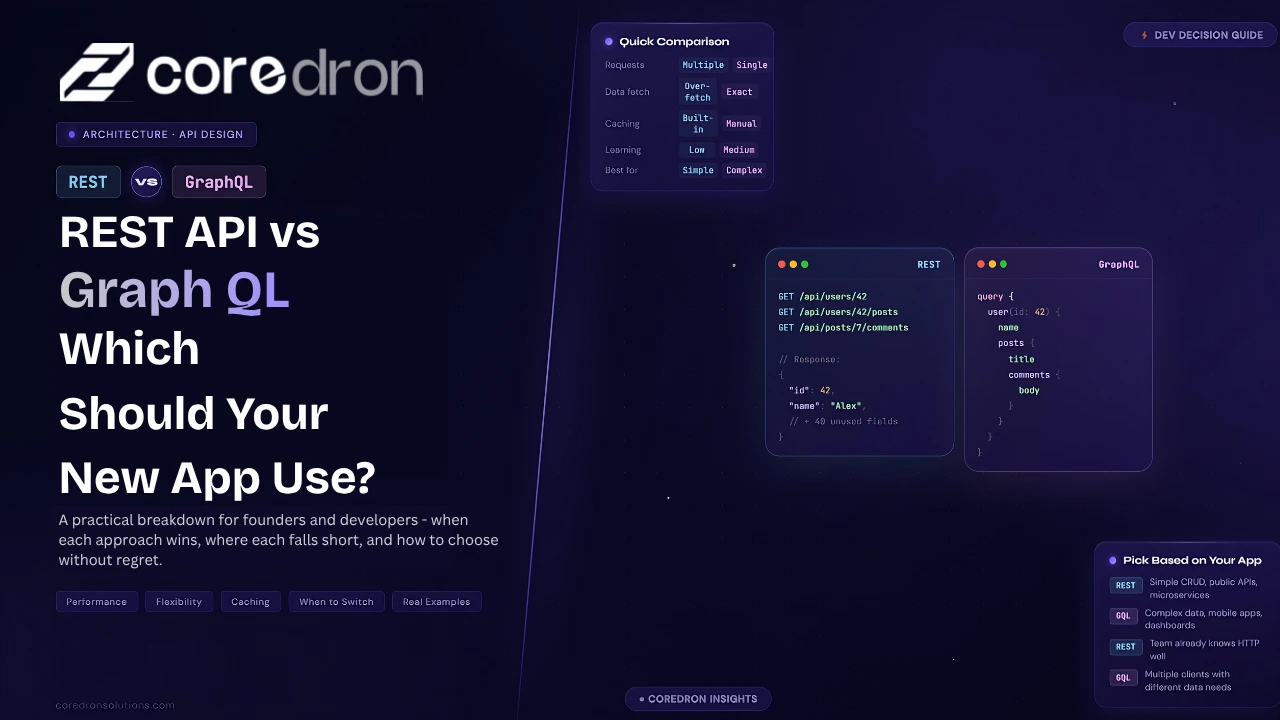
You’re early in development. The product is shaping up, the frontend is moving, and now the backend decisions start to matter.
This is usually where teams pause. Not because they don’t have options, but because they have too many. One of the most common debates at this stage is REST API vs GraphQL 2026.
On paper, both solve the same problem. They help your app talk to the server. But in practice, the way they handle data, performance, and scaling can feel very different.
That’s where the confusion kicks in.
Developers lean one way based on experience. Founders hear that GraphQL is “modern.” Product teams worry about speed and flexibility. And somewhere in between, the actual decision gets delayed.
It’s important to remember that there isn’t a universally “better” option.
It depends on your API architecture, your product complexity, and how your app is expected to grow. For example, teams building an API for mobile apps often run into data-fetching issues earlier than expected, which directly shapes this decision.
So instead of theory, this guide focuses on clarity.
We’ll break down a real REST vs GraphQL comparison, look at where each one fits, where they fall short, and what actually matters when you’re making this call in a real product environment.
By the end, you should have a clear direction. Not just what each option does, but which one makes sense for your app.
REST API vs GraphQL: Which Should You Choose?
- Use REST if your app is simple, needs fast development, and relies on caching.
- Use GraphQL if your app requires flexible data fetching, multiple clients, or complex UI.
The right choice depends on your app’s complexity, data structure, and scalability needs.
What Is REST API?
A REST API is just a way for your app to request data from a server using URLs. That’s the simplest way to look at it.
Everything is treated like a resource. Users, products, orders. Each one has its own endpoint. And you interact with those endpoints using methods like GET, POST, PUT, and DELETE.
So instead of one flexible system, REST spreads things out.
- If you need user data, you call one endpoint.
- If you need their orders, you make another request.
It’s structured, which is why most teams start here. You don’t need to overthink it. It just works.
But once the app grows a bit, especially in something like an API for mobile apps, things get slightly messy.
You start making multiple calls just to build one screen. Data comes from different places. Frontend ends up doing extra work.
That’s usually where people begin to notice REST’s limitations. Not immediately, but after real usage.
Simple REST Example
Say you need a user’s data.
Request
GET /users/123
Response
{
“id”: 123,
“name”: “John Doe”,
“email”: “john@example.com”
}
You ask for a user, you get everything defined for that user.
Now here’s the catch.
Even if you only needed the name, you still get the full response. And if you also needed related data, like orders, that’s another request entirely.
This is usually the point where the REST vs. GraphQL comparison becomes a real discussion, not just a theoretical one.
What Is GraphQL?
GraphQL is a way to request only the data you actually need, instead of getting a fixed response every time.
It works a bit differently from REST. Instead of hitting multiple endpoints, you send a single query and define exactly what fields you want back.
So the client controls the response, not the server.
This is where most GraphQL benefits start to show up. You avoid extra data, reduce unnecessary calls, and keep things tighter, especially in apps where performance matters.
In many cases, teams notice better GraphQL performance when dealing with complex screens or nested data. Instead of stitching together multiple responses, everything comes back in one go.
Simple GraphQL Example
Here’s what a basic query looks like:
Query
query {
user(id: 123) {
name
}
}
Response
{
“data”: {
“user”: {
“name”: “John Doe”,
“email”: “john@example.com”
}
}
}
Notice what’s happening here.
You’re only asking for name and email, so that’s all you get back. Nothing extra.
If you needed more fields, you’d just include them in the query. No new endpoint. No extra request.
That flexibility is exactly why the REST vs. GraphQL comparison leans toward GraphQL for more dynamic applications.
REST vs GraphQL: Key Differences Explained
At a high level, the difference looks simple.
- REST uses multiple endpoints.
- GraphQL uses a single endpoint with flexible queries.
But that surface-level view misses what actually changes in day-to-day development.
How is data fetched?
With REST, data is split across endpoints.
You hit /users, then maybe /orders, then something else. Each request brings back a fixed structure. If a screen needs data from different places, the frontend stitches it together.
That’s fine early on. But as the product grows, those extra calls start adding up. This is one of the more practical REST limitations teams run into, especially when building an API for mobile apps where network efficiency matters.
GraphQL flips that.
You hit one endpoint. Then you describe exactly what you need in a single query. Nested data, related fields, everything can come back in one response.
This reduces back-and-forth requests and simplifies frontend logic.
Flexibility vs predictability
REST is predictable.
Each endpoint is designed for a specific purpose. You know what you’ll get back every time. That makes it easy to reason about, debug, and maintain.
GraphQL is flexible.
The client decides the shape of the response. You can request only what you need or combine multiple data requirements into a single query.
That flexibility is where most GraphQL benefits come from. But it also means you need to think more carefully about how you structure your queries.
Performance in real scenarios
This is where the conversation usually shifts.
REST can lead to over-fetching or under-fetching. You either get more data than needed or make extra requests.
GraphQL reduces that by letting you control the payload.
In many real-world cases, teams see better GraphQL performance, not because it’s faster by default, but because it avoids unnecessary calls and reduces data transfer.
Still, it’s not automatic. Poorly designed queries can slow things down just as easily.
What it really comes down to:
If your app is simple and doesn’t need much flexibility, REST usually gets the job done without much overhead.
If your app deals with complex data, multiple views, or evolving requirements, GraphQL starts to make more sense.
The decision is less about which one is “better” and more about which one fits your API architecture and how your product is expected to grow.
REST API vs GraphQL Comparison Table
Here’s a quick overview to give you an idea of the difference between REST API and GraphQL:
| Criteria | REST API | GraphQL |
|---|---|---|
| Data Fetching | Fixed structure | Flexible queries |
| Endpoints | Multiple | Single |
| Over-fetching | Common | Avoided |
| Performance | Depends on endpoints | Optimized queries |
| Learning Curve | Easier | Slightly high |
| Use Case | Simple apps | Complex apps |
When Should You Use REST vs GraphQL?
| Scenario | Recommended Approach |
|---|---|
| Simple CRUD apps | REST |
| Complex frontend data needs | GraphQL |
| Mobile apps with bandwidth concerns | GraphQL |
| Legacy systems | REST |
| Rapid MVP development | REST |
| Real-time dashboards | GraphQL |
Performance and Scalability Considerations
This is where the decision usually becomes practical. Both REST and GraphQL scale well. They just optimize different things.
REST focuses on structure and caching. Whereas GraphQL focuses on reducing the number of requests and controlling data access.
REST Performance Factors
REST is straightforward. Each endpoint returns a fixed response. If a screen needs data from multiple endpoints, it makes multiple requests.
That’s manageable early on, but it can slow things down as the app grows. This is one of the common REST limitations. Where REST really shines is caching.
HTTP caching works out of the box. Browsers and CDNs can serve repeated requests quickly without hitting the server again. For apps with stable, repeat data, this is a big advantage.
GraphQL Performance Factors
GraphQL reduces the number of requests.
Instead of calling multiple endpoints, you fetch everything in one query. This makes a noticeable difference in mobile app APIs, where network delays are more visible.
You also control the response. Only the fields you ask for are returned. That’s where most GraphQL benefits come from.
But there’s a catch.
Performance depends on how queries are written. Complex or poorly structured queries can increase server load and affect GraphQL performance.
What matters in real use
- If your app relies on caching and simple data flows, REST works well.
- If your app needs flexible data fetching and fewer network calls, GraphQL tends to be more efficient.
That’s the core of this REST vs GraphQL comparison when it comes to performance.
Pros and Cons of REST API
REST has been around for a long time, and there’s a reason most teams still start with it.
What works well
Simpler implementation
You don’t need much setup. Endpoints, routes, standard methods. Most developers can get started quickly without learning something new.
Wide adoption
Tools, libraries, documentation, and community support. It’s all there. That makes development, hiring, and debugging a lot easier.
Where it starts to fall short
Limited flexibility
Responses are fixed. If you need slightly different data, you either modify the endpoint or create a new one. Over time, this adds up.
This is where most REST limitations show up, especially in growing products or complex API architecture setups.
Pros and Cons of GraphQL
GraphQL solves a few of those pain points, but it comes with its own trade-offs.
What works well
Flexible data fetching
You ask for exactly what you need. No extra fields, no unnecessary payload. This is one of the key GraphQL benefits teams notice early.
Reduced network calls
Multiple data requirements can be handled in a single query. That’s especially useful when building an API for mobile apps, where fewer requests make a difference.
Where it gets tricky
More complex setup
You need to manage schemas, resolvers, and query structure. It gives more control, but also adds overhead.
What this really means
This part of the REST vs GraphQL comparison is less about features and more about trade-offs.
REST is easier to start with.
GraphQL is more flexible once things grow. The better choice depends on how complex your app is likely to become.
When to Use REST API
REST makes sense when things are straightforward, and you don’t want extra complexity early on.
Here are situations where it fits naturally:
| Simple CRUD applications | If your app mostly creates, reads, updates, and deletes data, REST does the job without overthinking it. Clear endpoints, predictable behavior, and easy to maintain. |
|---|---|
| Public APIs | REST is still the default for public-facing APIs. It’s widely understood, easy to document, and works well with standard tools. That’s why most external integrations still rely on it. |
| Microservices architecture | In distributed systems, REST keeps communication between services simple. Each service exposes its own endpoints, and teams can work independently without tight coupling. |
| Teams with limited GraphQL experience | If your team hasn’t worked with GraphQL before, REST is the safer starting point. It reduces the learning curve and helps you move faster in the early stages. |
In short, REST works best when you value simplicity, predictability, and quick setup.
That’s why, even in REST API vs. GraphQL 2026 discussions, many teams still begin with REST and only reconsider the decision when complexity increases.
When to Use GraphQL
GraphQL starts to make more sense once your data needs are no longer simple. Not at day one. Usually, a bit later, when the frontend starts asking for more flexibility.
Here’s where it fits naturally:
| Complex, data-heavy applications | If your app pulls related data from multiple sources, GraphQL helps keep things cleaner. Instead of hitting several endpoints, you can fetch everything in one query. That’s one of the more practical GraphQL benefits. |
|---|---|
| Mobile apps requiring optimized data usage | Mobile apps don’t always have stable networks. Sending smaller, precise responses makes a difference. This is why GraphQL is often preferred as an API for mobile apps, where reducing payload size and the number of calls matters. |
| Multiple frontend clients | If you’re supporting web, mobile, and maybe even third-party apps, GraphQL gives each client the freedom to request what it needs. No need to keep creating new endpoints for every variation. |
| Rapid iteration environments | When product requirements change frequently, GraphQL is easier to adapt to. You can adjust queries on the frontend without constantly modifying the backend structure. |
In short, GraphQL works best when flexibility and efficiency start becoming more important than simplicity.
That’s usually the point where the REST vs GraphQL comparison shifts in its favor.
Real-World Use Cases
This isn’t just theory. Both REST and GraphQL are used at scale. The choice usually reflects product needs, not trends.
Companies Using REST
Uses REST for many public APIs. It keeps things predictable and easier for external developers to integrate.
GitHub
Built its ecosystem on REST APIs for years. Clear endpoints and strong documentation made it widely accessible.
Companies Using GraphQL
Originally developed GraphQL to handle complex, data-heavy apps. It helped reduce the number of requests and improve efficiency at scale.
Shopify
Uses GraphQL to support flexible data needs across different storefronts and apps. It allows clients to request exactly what they need without overloading responses.
Takeaway
There’s no strict divide. REST works well where stability and simplicity matter. GraphQL shows its strength where flexibility and scale become priorities.
CoreDron’s Recommendation
There’s no one-size-fits-all answer here. The right choice depends on what you’re building and how quickly you need to move.
When REST makes more sense
Simpler apps
If your data flow is straightforward, REST keeps things clean. You don’t need extra layers or complexity.
Faster MVPs
When speed matters, REST helps you get something working quickly. Less setup, fewer moving parts, easier to iterate early.
When GraphQL is the better fit
Data-heavy apps
If your app pulls data from multiple sources or needs nested responses, GraphQL handles it more efficiently. That’s where most GraphQL benefits come in.
Complex UI requirements
When different screens need different slices of data, GraphQL gives the frontend more control without constantly changing the backend.
Final call
Think in phases: start simple if you’re early, then adopt greater flexibility when your product requires it.
That’s usually the most practical way to approach the REST API vs GraphQL 2026 decision.
Conclusion
Both REST and GraphQL have clear strengths.
REST keeps things simple and predictable. : GraphQL gives you flexibility as data needs grow.
The right choice depends on how complex your app is today and how you expect it to scale. Not every product needs GraphQL from day one.
In most cases, it makes sense to start simple and evolve when the need becomes real. That’s usually a more practical approach than over-engineering early.